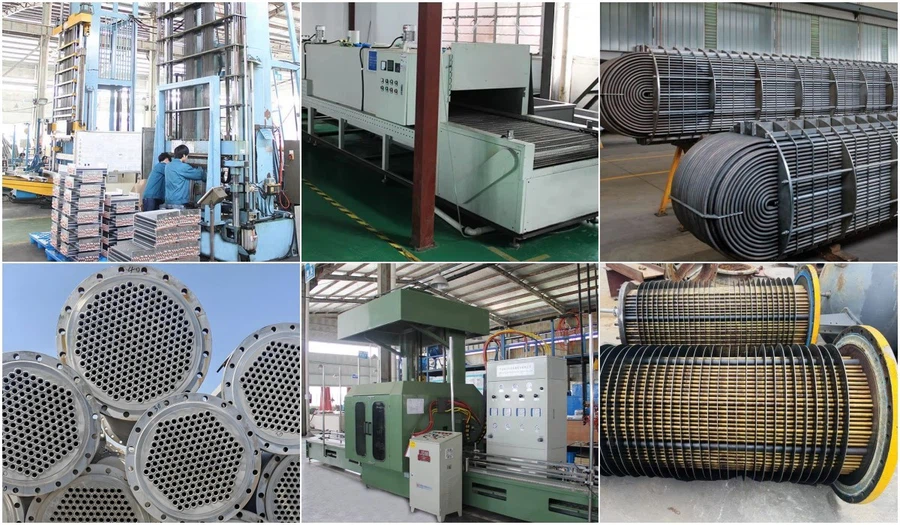
JIS H3300 vs ASTM B111: Copper Alloy Tube Standards Comparison
In numerous industrial sectors such as power plants, ships, petrochemicals, air conditioning, and refrigeration, heat exchangers function like the "lungs" of a system, constantly facilitating heat exchange. The core building material of this "energy bridge" is the copper alloy tube. Its performance directly determines the efficiency, service life, and reliability of the entire equipment.
When selecting production standards and grades for copper alloy tubes, several standards are typically available, including JIS H3300 and ASTM B111. Among these, ASTM B111 is the most widely applied standard.
JIS H3300: Japanese Standard for Copper and Copper Alloy Seamless Pipes and Tubes
ASTM B111: American Standard for Copper and Copper-Alloy Seamless Condenser Tubes and Ferrule Stock
Standard JIS H3300 vs ASTM B111 Scope of Application Comparison
Similarity: Both JIS H3300 and ASTM B111 specify that copper alloy tubes can be used in equipment like heat exchangers, evaporators, and condensers.
Difference: Compared to ASTM B111, JIS H3300 also specifies copper alloy tubes for use in water supply pipelines and air conditioning refrigeration.
Materials Comparison of JIS H3300 & ASTM B111
The table below lists all the grades from the ASTM B111 and JIS H3300 standards. JIS and ASTM have their own grade designation systems. While many grades have equivalents, they are not entirely one-to-one. Each standard may include some unique grades or have different subdivisions for the same type of alloy. The Japanese standard JIS H3300 divides grades more finely into ordinary class and special class, with the latter having more precise dimensions and tighter tolerances.
| ASTM B111 | JIS H3300 |
|---|---|
| C10100 | - |
| C10200 | C1020/C1020T/C1020TS |
| C10300 | - |
| C10800 | - |
| - | C1100/C1100T/C1100TS |
| C12000 | - |
| - | C1201/C1201T/C1201TS |
| C12200 | C1220/C1220T/C1220TS |
| - | C1260/C1260T/C1260TS |
| C14200 | - |
| - | C1565/C1565T/C1565TS |
| C19200 | - |
| - | C2200/C2200T/C2200TS |
| C23000 | C2300/C2300T/C2300TS |
| - | C2600/C2600T/C2600TS |
| - | C2700/C2700T/C2700TS |
| C28000 | C2800/C2800T/C2800TS |
| C44300 | C4430/C4430T/C4430TS |
| C44400 | - |
| C44500 | - |
| - | C5010/C5010T/C5010TS |
| - | C5015/C5015T/C5015TS |
| C60800 | - |
| C61300 | - |
| C61400 | - |
| C68700 | C6870/C6870T/C6870TS |
| - | C6871/C6871T/C6871TS |
| - | C6872/C6872T/C6872TS |
| C70400 | - |
| C70600 | C7060/C7060T/C7060TS |
| C70620 | - |
| C71000 | C7100/C7100T/C7100TS |
| C71500 | C7150/C7150T/C7150TS |
| C71520 | - |
| C71640 | C7164/C7164T/C7164TS |
| C72200 | - |
Chemical Composition
According to the technical specification documents of both JIS H3300 and ASTM B111 standards, for common and mature copper alloy materials, the regulations for main alloying elements are essentially identical, with only minor differences in the content of certain elements.
Mechanical Properties
Similarities:
① Both standards specify key mechanical property indicators:
Minimum Tensile Strength
Minimum 0.2% Proof Strength (Yield Strength)
Minimum Elongation after Fracture
② Both standards clearly state that mechanical properties are closely related to the materials "Temper." Requirements are specified separately for soft (annealed) states and various hard (cold-worked) states.
Differences:
Compared to ASTM B111, JIS H3300 additionally provides detailed regulations for the tubes hardness. If required by the buyer, hardness should be used, and when hardness is used, tensile strength and elongation should not be used.
Furthermore, JIS H3300 includes descriptions and specifies relevant performance parameters for high-strength copper and copper alloy tubes used in pressure vessels.
JIS H3300 vs ASTM B111 Copper Alloy Tube Temper Comparison
Since mechanical properties are intimately related to the state of the copper alloy, the JIS and ASTM standards assign the following heat treatment symbols based on the heat treatment state of the copper tube:
| JIS H3300 | ASTM B111 | ||
|---|---|---|---|
| O | Fully recrystallized or annealed | O61 | Annealed |
| OL | Annealed or lightly worked | HR50 | Drawn and stress-relieved |
| 1/2H | Half hard | H55 | Light-drawn |
| 3/4H | 3/4 hard | H80 | Hard-drawn |
| H | Fully hard | HE80 | Hard-drawn and end annealed |
O temper (Annealed): Full Annealing
→ Heated to a relatively high temperature with sufficient holding time, allowing full recrystallization within the material, almost completely eliminating internal stresses and work-hardening effects from cold working, restoring the material to its softest and most ductile state.
OL temper (Light Annealed): Light Annealing
→ Heated to a relatively lower temperature, possibly with a shorter holding time; annealing is incomplete. It partially relieves internal stress and work hardening but retains some of the strength from cold working, representing a state between "hard" and "fully soft."
Copper tubes can be categorized as "soft copper tubes," "hard copper tubes," and "half-hard copper tubes." These distinctions stem from different heat treatment processes.
Pure copper becomes hard after drawing, rolling, or stretching at room temperature, forming so-called "hard copper." Hard copper has high tensile strength but lower conductivity. Therefore, to improve the workability and conductivity of pure copper, a "continuous softening method" is adopted: hard copper is placed in an annealing furnace heated to 250-350°C, or heated by electric current for "self-annealing," and then coiled.
The copper alloy tube temper depends on the final usage requirements:
O temper: Required for extensive bending, tube expanding, flaring processing.
Hard temper: Required for high strength, vibration resistance, and erosion resistance.
OL temper: Only mild forming operations are needed, but slightly higher strength and stiffness (slightly better collapse resistance, vibration resistance) are desired after forming.
Dimensional Tolerances Comparison of JIS H3300 and ASTM B111
Outside Diameter Tolerances
In accordance with JIS H3300
| OD or ID (mm) | Ordinary Class | Special Class |
|---|---|---|
| 4≤D≤15 | ±0.08 mm | ±0.05 mm |
| 15<D≤25 | ±0.09 mm | ±0.06 mm |
| 25<D≤50 | ±0.12 mm | ±0.08 mm |
| 50<D≤75 | ±0.15 mm | ±0.1 mm |
| 75<D≤100 | ±0.2 mm | ±0.13 mm |
| 100<D≤125 | ±0.27 mm | ±0.15 mm |
| 125<D≤150 | ±0.35 mm | ±0.18 mm |
| 150<D≤200 | ±0.5 mm | - |
| 200<D≤250 | ±0.65 mm | - |
| 250<D≤350 | ±0.4% | - |
According to JIS H3300, the following outside diameter tolerances apply to copper alloy tubes for heat exchangers: C4430, C6870, C6871, C6872, C7060, C7100, C7150, and C7164.
| OD (mm) | Ordinary Class | Special Class | |
|---|---|---|---|
| WT≤1.1mm | WT>1.1mm | ||
| 5≤D≤10 | +0 mm / -0.15 mm | +0 mm / -0.10 mm | +0 mm / -0.10 mm |
| 10<D≤20 | +0 mm / -0.25 mm | +0 mm / -0.20 mm | +0 mm / -0.17 mm |
| 20<D≤30 | +0 mm / -0.40 mm | +0 mm / -0.30 mm | +0 mm / -0.22 mm |
| 30<D≤50 | +0 mm / -0.60 mm | +0 mm / -0.40 mm | +0 mm / -0.30 mm |
In accordance with ASTM B111
| OD (mm) | WT (mm) | |||||||
|---|---|---|---|---|---|---|---|---|
| 0.508 | 0.559 | 0.635 | 0.711 | 0.813 | 0.889 | 1.07 | ≥1.24 | |
| OD≤12 | ±0.076 mm | ±0.064 | ±0.064 | ±0.064 | ±0.064 | ±0.064 | ±0.064 | ±0.064 |
| 12<OD≤18 | ±0.1 | ±0.1 | ±0.1 | ±0.089 | ±0.076 | ±0.076 | ±0.076 | ±0.076 |
| 18<OD≤25 | ±0.15 | ±0.15 | ±0.13 | ±0.11 | ±0.1 | ±0.1 | ±0.1 | ±0.1 |
| 25<OD≤35 | - | - | - | ±0.2 | ±0.13 | ±0.13 | ±0.13 | ±0.13 |
| 35<OD≤50 | - | - | - | - | ±0.15 | ±0.15 | ±0.15 | ±0.15 |
| 50<OD≤79 | - | - | - | - | ±0.17 | ±0.17 | ±0.17 | ±0.17 |
Wall Thickness Tolerances
In accordance with JIS H3300
| OD (mm) | WT (mm) | |||||||||
|---|---|---|---|---|---|---|---|---|---|---|
| 0.25≤WT≤0.4 | 0.4<WT≤0.6 | 0.6<WT≤0.8 | 0.8<WT≤1.4 | 1.4<WT≤2 | 2<WT≤3 | 3<WT≤4 | 4<WT≤5.5 | 5.5<WT≤7 | WT>7 | |
| Ordinary Class | ||||||||||
| 4≤OD≤15 | ±0.06 | ±0.07 | ±0.10 | ±0.13 | ±0.15 | ±0.18 | - | - | - | - |
| 15<OD≤25 | ±0.07 | ±0.08 | ±0.10 | ±0.15 | ±0.18 | ±0.20 | ±0.30 | ±0.40 | ±0.45 | - |
| 25<OD≤50 | - | ±0.09 | ±0.11 | ±0.15 | ±0.18 | ±0.20 | ±0.30 | ±0.40 | ±0.45 | ±8% |
| 50<OD≤100 | - | - | ±0.15 | ±0.18 | ±0.22 | ±0.25 | ±0.30 | ±0.40 | ±0.45 | ±8% |
| 100<OD≤175 | - | - | - | ±0.22 | ±0.25 | ±0.30 | ±0.35 | ±0.42 | ±0.45 | ±9% |
| 175<OD≤250 | - | - | - | - | ±0.30 | ±0.35 | ±0.40 | ±0.45 | ±0.50 | ±9% |
| 250<OD≤300 | - | - | - | - | - | ±0.40 | ±0.45 | ±0.45 | ±0.50 | ±10% |
| 300<OD≤350 | - | - | - | - | - | - | ±0.50 | ±0.50 | ±0.60 | ±12% |
| Special Class | ||||||||||
| 4≤OD≤15 | ±0.03 | ±0.05 | ±0.06 | ±0.08 | ±0.09 | ±0.10 | - | - | - | - |
| 15<OD≤25 | ±0.04 | ±0.05 | ±0.06 | ±0.09 | ±0.10 | ±0.13 | ±0.15 | - | - | - |
| 25<OD≤50 | - | ±0.06 | ±0.08 | ±0.09 | ±0.10 | ±0.13 | ±0.18 | - | - | - |
| 50<OD≤100 | - | - | ±0.10 | ±0.13 | ±0.15 | ±0.18 | ±0.20 | - | - | - |
In accordance with ASTM B111
| WT (mm) | OD (mm) | ||
|---|---|---|---|
| 12<OD≤25 | 25<OD≤50 | 50<OD≤80 | |
| 0.5≤WT<0.8 | ±0.08 | - | - |
| 0.8≤WT<0.9 | ±0.08 | ±0.10 | - |
| 0.9≤WT<1.5 | ±0.11 | ±0.11 | ±0.13 |
| 1.5≤WT<2.1 | ±0.13 | ±0.13 | ±0.14 |
| 2.1≤WT<3 | ±0.17 | ±0.17 | ±0.17 |
| 3≤WT<3.4 | ±0.18 | ±0.19 | ±0.20 |
JIS H3300 vs ASTM B111 Copper Alloy Tube Grain Size Comparison
Both JIS H3300 and ASTM B111 explicitly specify grain size requirements only for materials in the annealed condition, with no requirements for the hard temper.
In accordance with JIS H3300
| Grade | Temper | Grain Size (mm) |
|---|---|---|
| C1020/C1201/C1220/C1260 | O | 0.025-0.060 |
| OL | ≤0.040 | |
| C1565/C1862/C5010/C5015 | O | ≤0.040 |
| C2200/C2300/C2600/C2700 | O | 0.025-0.060 |
| OL | ≤0.035 | |
| C4430/C6870/C6871/C6872/C7060/C7100/C7150/C7164 | O | 0.010-0.045 |
ASTM B111 stipulates that the average grain size for copper alloy tubes, except for C19200 and C28000, should be within the range of 0.010-0.045 mm.
Discuss Your Project Requirements
Why do JIS H3300 and ASTM B111 only have grain size requirements for annealed copper alloy tubes?
The reason behind this stems from a fundamental principle of materials science: the microstructure of a material determines its macroscopic properties, and the dominant microstructural feature differs under various processing conditions.
Annealed Condition (O temper): Grain size is the core control indicator.
Annealing is a heat treatment process involving recrystallization and grain growth. After cold working, the material's internal grains are fragmented and full of defects (dislocations), placing it in a high-energy, unstable state. Annealing heating provides energy for new grains to nucleate and grow, forming new, strain-free equiaxed grains.
In this state, grain size becomes the most critical microstructural factor influencing the material's properties.
For tubes requiring subsequent operations like expanding or bending (e.g., heat exchanger tubes), uniform, fine grains are crucial. Coarse grains can lead to "orange peel" surface appearance and are prone to cracking during processing.
Hardened Condition (H temper): The amount of cold work deformation (or the final mechanical properties) is the core control indicator; the original grain size is no longer key.
The hardened condition (e.g., H14, H18) is achieved through cold working (e.g., drawing, rolling), not heat treatment. During this process, the morphology of the grains changes; the original equiaxed grains are elongated and fragmented, forming a fibrous deformed structure.
Therefore, for hardened materials, the standards directly specify mechanical properties (such as tensile strength, yield strength, elongation) or hardness, which is more direct, effective, and reliable than specifying a "grain size" that is difficult to measure accurately and does not play a dominant role.
JIS H3300 vs ASTM B111 Copper Alloy Tube Application
JIS H3300: East Asian region projects, high-precision heat exchanger tubes, air conditioning and refrigeration industry.
ASTM B111: North American and European markets, marine environments, or highly corrosive conditions (e.g., power plant condensers).
FAQ
Q1: Which standard should I choose for a heat exchanger project going to Japan or South Korea?
A: For projects in East Asian regions like Japan or South Korea, JIS H3300 is typically specified. It is widely accepted and often required for local compliance. For European or North American destinations, ASTM B111 is the common choice.
Q2: Can I use an ASTM B111 C12200 tube in place of a JIS H3300 C1220T tube?
A: Yes, these are considered equivalent grades for phosphorus-deoxidized copper. Their chemical compositions and required mechanical properties for annealed temper are largely interchangeable. However, always check the specific dimensional tolerances required by your design, as JIS H3300 offers an optional "Special Class" with tighter tolerances.
Q3: My tubes need to be bent into a U-shape. What temper should I order?
A: You should order the O temper (fully annealed). Both standards specify O temper (O for JIS, O61 for ASTM) for extensive bending, tube expanding, or flaring. Hard tempers are likely to crack during U-bending.
Q4: Does a harder temper mean better corrosion resistance?
A: Not directly. Corrosion resistance is primarily determined by the alloy's chemical composition (e.g., C70600 copper-nickel for seawater). However, a harder temper offers higher strength and better erosion resistance from high-velocity fluids. For stagnant or low-flow corrosive conditions, the softer O temper is often preferred.
Q5: The JIS standard mentions "Ordinary Class" and "Special Class" for tolerances. Which one should I buy?
A: It depends on your design requirements. Ordinary Class is standard and more economical. Special Class offers tighter outside diameter and wall thickness tolerances. Choose Special Class if you have very precise fit-up requirements, such as for mechanically expanded tubes into thick tubesheets, or for very long tube lengths where cumulative tolerance is a concern.
Q6: Are there any grain size requirements for hard-drawn (H80/HE80) tubes under ASTM B111?
A: No. Both ASTM B111 and JIS H3300 only specify grain size requirements for annealed (O/O61) or lightly annealed (OL) tempers. For hard tempers, the standards control properties through mechanical strength (tensile/yield) and hardness because the deformed grain structure is no longer characterized by a simple average grain size.
Q7: I need high strength for a high-pressure application. Which standard offers stronger tubes?
A: Both standards cover high-strength alloys, but JIS H3300 explicitly includes a category for "high-strength copper and copper alloy tubes used in pressure vessels." You should compare the specific yield strength of a chosen grade, such as C7060 (JIS) vs. C70600 (ASTM). For critical pressure applications, also verify the required temper (e.g., H80 for ASTM, H for JIS) and always confirm with your design code.
How Do We Package Copper Heat Exchanger Tubes for Global Delivery?
Poor packaging destroys even the best copper heat exchanger tube. As a professional copper heat exchanger tube factory serving copper heat exchanger tube USA, Europe, UAE, Saudi Arabia, and India, we follow military-grade export packaging standards to ensure zero damage during sea or air freight.
Our Standard Packaging Process:
| Packaging Stage | Material / Method | Purpose |
|---|---|---|
| Individual Tube Protection | Anti-rust VCI paper + plastic end caps | Prevents moisture, dust, and scratches on copper tube heat exchanger inner surfaces. |
| Bundling | Nylon straps + wooden spacers | Keeps copper heat exchanger tube OD 19mm, 1 inch, or 5/8 inch sizes organized and vibration-free. |
| Moisture Barrier | Thick PE film wrap (heat-shrunk) | Blocks humidity during long sea voyages to copper heat exchanger tube Germany or Saudi Arabia. |
| Outer Packing | Export-grade plywood cases or steel-banded wooden crates | Withstands stacking and rough handling. Each crate labeled with PO number, alloy (e.g., SB111 C70600), and quantity. |
| Documentation | Packing list + Mill Test Certificate (MTC) attached outside | Customs clearance support for copper heat exchanger tube stockist and distributor partners. |
For U-Bundle Orders: U tube heat exchanger and U tube bundle heat exchanger are placed in dedicated steel jigs inside the crate to prevent bending radius distortion.
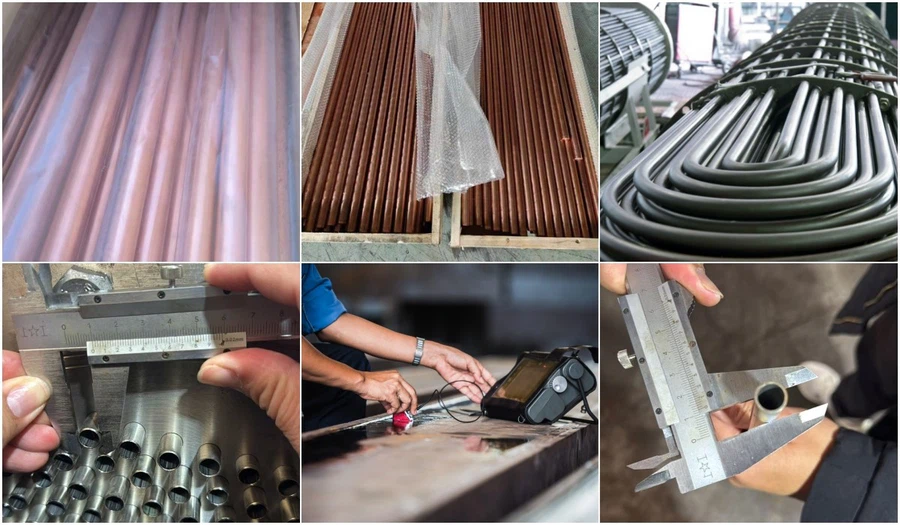
Our Factory & Equipment
| Equipment Type | Specification / Capability | Quality Impact |
|---|---|---|
| Horizontal Continuous Casting Line | 10-ton capacity | Produces homogeneous copper alloy tube for heat exchanger billets with zero porosity. |
| Three-Roll Piercing Mill | Up to 60mm OD | Precision wall thickness control for heat exchanger tube wall thickness as low as 0.5mm. |
| Cold Drawing Bench | 5 draws in sequence | Achieves tight tolerances on copper heat exchanger tube length and heat exchanger pipe diameter. |
| Straightening & Cutting Line | CNC servo-controlled | Burr-free cutting for copper heat exchanger tube 3/4 inch and 1 inch to exact project lengths. |
| U-Bending Machine | CNC mandrel type | Produces u tube condenser and U tube bundle heat exchanger without kinking or ovality. |
| Eddy Current Tester | NDT (Non-Destructive Testing) | 100% inspection of C70600 tube and C71500 tube for pinholes or cracks per ASTM B111 pdf standards. |
| Hydrostatic Tester | Up to 200 bar | Validates heat exchanger tube expansion and tube rolling integrity. |
| Spectrometer | Optical emission (OES) | Confirms chemical composition of ASME SB111, EN 12451, and JIS H3300 grades on every batch. |
Our Certifications & Compliance:
ASTM B111 pdf and ASME SB111 pdf full traceability.
ISO 9001:2015 quality management system.
Third-party inspection accepted: SGS, BV, Lloyds, or TUV.
Copper heat exchanger tube life expectancy testing reports available upon request.