

GNEE is a notable manufacturer, supplier, exporter, and stockist of ASTM B42 C12200 Copper Pipe & Tube in Henan Province, China. ASTM B75 Copper Tubes are manufactured by hot and cold-working processes, shall be cold drawn to the finished size and wall thickness, and shall be supplied in cold-drawn or annealed temper condition. We manufacture these Copper C12200 Pipes and Tubes in various sizes, specifications, wall thickness, dimensions, types, and also in customized specifications as per client requirements at reasonable prices.
What are C12200 copper pipes?
C12200, Phosphorus deoxidized copper, has been made weldable and brazeable by deoxidizing with phosphorus. Copper C12200 has almost exactly the same mechanical properties as high purity copper alloys such as C11000. ASTM B42 Copper Pipes have excellent deep drawing characteristics and resistance to pitting corrosion when exposed to severe weather and water environments.
ASTM B42 Seamless Copper Pipes are suitable for use in plumbing, boiler feed lines, and for similar purposes. ASTM B75 Copper Seamless Tubes are available in various standard specifications like round, square, or rectangular and are suitable for general engineering applications.
ASTM B42 Copper C12200 Seamless Pipes are frequently used for corrosion resistance. They may be used with most types of water and can even be utilized underground due to their resistance to soil corrosion. ASTM B75 Copper C12200 Tubes are immune to non-oxidizing mineral and organic acids, caustic solutions, and saline solutions.
Typical Applications
| Application Area |
|---|
| Hot and cold water tubes |
| Gas and heating installations |
| Soil and waste pipes |
| Storage tanks |
| Roofing and building facades |
| Evaporators and heat exchangers |
| Chemical equipment |
| Anodes for electroplating baths |
Testing Conducted
| Test Type |
|---|
| Grain size test |
| Electrical resistivity test |
| Tensile and yield strength test |
| Hardness test |
| Expansion test |
| Microscopical examination |
| Hydrogen embrittlement test |
| Nondestructive tests (electromagnetic, eddy current) |
| Hydrostatic and pneumatic pressure tests |
Types of ASTM B42 / B75 C12200 Copper Pipe & Tube
| Product Type | Specifications |
|---|---|
| Seamless Pipe | ASME SB42, UNS C12200, ASTM B42, C12200 DHP |
| Seamless Tube | ASME SB75, UNS C12200, ASTM B75, C12200 DHP |
ASTM B42 / B75 C12200 Copper Pipe & Tube
| Parameter | Details |
|---|---|
| Specifications | ASTM B42, B75 / ASME SB42, SB75 |
| Standard | ASTM, ASME, API |
| Pipe Size | 15″ NB – 150″ NB |
| Outside Diameter | 1.250″ – 6.000″ (30-150 mm) |
| Wall Range | 0.095″ – 1.000″ (2.5-25 mm) |
| Length | Single Random, Double Random, or Required Length |
| Thickness | 0.3 mm – 50 mm |
| Schedule | SCH20, SCH30, SCH40, STD, SCH80, XS, SCH120, SCH140, SCH160, XXS |
| Type | Seamless, Welded, ERW |
| End | Plain End, Beveled End, Threaded |
Sizes – Nominal Pipe Size to Outside Diameter
| NPS (mm) | NPS (inch) | OD (mm) |
|---|---|---|
| 3 mm | 1/8″ | 10.3 |
| 6 mm | 1/4″ | 13.7 |
| 10 mm | 3/8″ | 17.1 |
| 15 mm | 1/2″ | 21.3 |
| 20 mm | 3/4″ | 26.7 |
| 25 mm | 1″ | 33.4 |
| 32 mm | 1-1/4″ | 42.2 |
| 40 mm | 1-1/2″ | 48.3 |
| 50 mm | 2″ | 60.3 |
| 65 mm | 2-1/2″ | 73.0 |
| 80 mm | 3″ | 88.9 |
| 100 mm | 4″ | 114.3 |
| 125 mm | 5″ | 141.3 |
| 150 mm | 6″ | 168.3 |
| 200 mm | 8″ | 219.1 |
| 250 mm | 10″ | 273.1 |
| 300 mm | 12″ | 323.8 |
| 350 mm | 14″ | 355.6 |
| 400 mm | 16″ | 406.4 |
| 450 mm | 18″ | 457.2 |
| 500 mm | 20″ | 508.0 |
| 600 mm | 24″ | 610.0 |
Schedule Chart – Wall Thickness and Weight (SCH 40, 80, 160)
| NPS | OD (mm) | SCH 40 (mm / kg/m) | SCH 80 (mm / kg/m) | SCH 160 (mm / kg/m) |
|---|---|---|---|---|
| 1/8″ | 10.29 | 2.41 / 0.48 | - | - |
| 1/4″ | 13.72 | 2.24 / 0.64 | 3.02 / 0.81 | - |
| 3/8″ | 17.15 | 2.31 / 0.86 | 3.20 / 1.12 | - |
| 1/2″ | 21.34 | 2.77 / 1.29 | 3.73 / 1.64 | 7.47 / 2.65 |
| 3/4″ | 26.67 | 2.87 / 1.71 | 3.91 / 2.23 | 7.82 / 3.69 |
| 1″ | 33.40 | 3.38 / 2.54 | 4.55 / 3.28 | 9.09 / 5.75 |
| 1-1/4″ | 42.16 | 3.56 / 3.43 | 4.85 / 3.53 | 9.70 / 7.88 |
| 1-1/2″ | 48.26 | 3.68 / 3.11 | 5.08 / 5.49 | 10.16 / 9.69 |
| 2″ | 60.33 | 3.91 / 5.52 | 5.54 / 7.59 | 11.07 / 13.65 |
| 2-1/2″ | 73.03 | 5.16 / 8.76 | 7.01 / 11.58 | - |
| 3″ | 88.90 | 5.49 / 11.45 | 7.62 / 15.50 | 15.24 / 28.09 |
| 4″ | 114.30 | 6.02 / 16.31 | 8.56 / 22.65 | 17.12 / 41.63 |
| 5″ | 141.60 | 6.55 / 22.10 | 9.52 / 31.41 | - |
| 6″ | 168.26 | 7.11 / 28.68 | 10.97 / 43.19 | 21.95 / 80.36 |
| 8″ | 219.08 | 8.18 / 43.16 | 12.70 / 65.59 | 18.26 / 90.44 |
| 10″ | 273.05 | 9.27 / 61.20 | 12.70 / 81.55 | - |
| 12″ | 323.85 | 9.53 / 74.92 | 12.70 / 97.46 | - |
Pressure Rating (psig) – ASTM B42 / B75 C12200 Copper Pipe
| Pipe Size | Schedule | 100°F | 200°F | 300°F | 400°F | 500°F | 600°F |
|---|---|---|---|---|---|---|---|
| 1″ | 40 | 3048 | 2629 | 2362 | 2171 | 2019 | 1924 |
| 1″ | 80 | 4213 | 3634 | 3265 | 3002 | 2791 | 2659 |
| 1″ | 160 | 6140 | 5296 | 4759 | 4375 | 4068 | 3876 |
| 1-1/2″ | 40 | 2257 | 1947 | 1750 | 1608 | 1496 | 1425 |
| 1-1/2″ | 80 | 3182 | 2744 | 2466 | 2267 | 2108 | 2009 |
| 1-1/2″ | 160 | 4619 | 3984 | 3580 | 3291 | 3060 | 2916 |
| 2″ | 40 | 1902 | 1640 | 1474 | 1355 | 1260 | 1201 |
| 2″ | 80 | 2747 | 2369 | 2129 | 1957 | 1820 | 1734 |
| 2″ | 160 | 4499 | 3880 | 3486 | 3205 | 2980 | 2840 |
| 3″ | 40 | 1806 | 1558 | 1400 | 1287 | 1196 | 1140 |
| 3″ | 80 | 2553 | 2202 | 1979 | 1819 | 1691 | 1612 |
| 3″ | 160 | 3840 | 3312 | 2976 | 2736 | 2544 | 2424 |
| 4″ | 40 | 1531 | 1321 | 1187 | 1091 | 1014 | 967 |
| 4″ | 80 | 2213 | 1909 | 1715 | 1577 | 1466 | 1397 |
| 4″ | 160 | 3601 | 3106 | 2791 | 2566 | 2386 | 2273 |
| 6″ | 40 | 1219 | 1052 | 945 | 869 | 808 | 770 |
| 6″ | 80 | 1913 | 1650 | 1483 | 1363 | 1267 | 1208 |
| 6″ | 160 | 3289 | 2836 | 2549 | 2343 | 2179 | 2076 |
| 8″ | 40 | 1073 | 926 | 832 | 765 | 711 | 678 |
| 8″ | 80 | 1692 | 1459 | 1311 | 1205 | 1121 | 1068 |
| 10″ | 40 | 974 | 840 | 755 | 694 | 645 | 615 |
| 10″ | 80 | 1609 | 1388 | 1247 | 1147 | 1066 | 1016 |
FAQ
Q1: What is the difference between ASTM B42 and ASTM B75?
A: ASTM B42 covers seamless copper pipe for plumbing and boiler feed lines, using standard pipe sizes (NPS). ASTM B75 covers seamless copper tube for general engineering applications, available in round, square, or rectangular shapes. Both use C12200 material. B75 also allows drawn or annealed tempers; B42 is typically supplied in annealed temper.
Q2: What is the difference between C12200 and C11000?
A: C12200 contains 0.015-0.040% phosphorus for deoxidation, making it resistant to hydrogen embrittlement during brazing and welding. C11000 contains oxygen and cannot be brazed in reducing atmospheres. For plumbing, boiler lines, and heat exchangers where brazing is required, C12200 is the standard. C11000 is used for high-conductivity electrical applications.
Q3: What is the difference between C12200 and C10200?
A: C10200 is oxygen-free copper with 99.95% minimum copper and 0.001% oxygen maximum, giving it 100% IACS conductivity. C12200 contains phosphorus and has 85% IACS conductivity. C10200 is used for high-vacuum electron tubes and critical electronic components. C12200 is the standard for plumbing, HVAC, and general engineering. C10200 costs significantly more.
Q4: What is the difference between C12200 and CW024A?
A: CW024A is the European EN designation for phosphorus-deoxidized copper (Cu-DHP). C12200 is the UNS designation (USA). Both require 0.015-0.040% phosphorus and minimum 99.90% copper. They are fully interchangeable. The only difference is the marking on the tube and the certifying standard. EN standards use CW024A; ASTM uses C12200.
Q5: What does DHP mean in copper pipe?
A: DHP stands for "Deoxidized High Phosphorus." It is the exact same material as UNS C12200. DHP is the common name used in European and Asian markets. The "high phosphorus" refers to the 0.015-0.040% phosphorus content added to remove oxygen from the copper melt. DHP copper is weldable and brazeable without hydrogen embrittlement.
Q6: What is the difference between annealed and hard drawn C12200 tube?
A: Annealed (soft) C12200 tube has been heated and slowly cooled, making it ductile and easy to bend or flare. Hard drawn C12200 tube is cold worked, giving it higher strength but very low ductility – it cannot be bent without cracking. For field bending, use annealed. For straight rigid lines, hard drawn is acceptable. ASTM B75 offers both.
Q7: Can C12200 copper pipe be welded or only brazed?
A: C12200 can be both welded and brazed. For plumbing, brazing (1100-1500°F with silver-phosphorus alloy) or soldering (400-500°F) is standard. For industrial applications, C12200 can be TIG welded using ERCu filler metal. Because C12200 contains phosphorus, it is resistant to hydrogen embrittlement during welding. C11000 cannot be welded due to oxygen content.
Q8: What testing is required for ASTM B42 C12200 pipe?
A: Required tests include: chemical analysis (Cu and P), tensile strength, yield strength, hardness, expansion test (ductility), flattening test, grain size examination, hydrogen embrittlement test (microscopical), eddy current (nondestructive), and hydrostatic or pneumatic pressure test. GNEE provides mill test reports certifying all tests.
Q9: Is C12200 copper pipe suitable for underground burial?
A: Yes, C12200 copper pipe is suitable for underground water and gas lines due to its excellent resistance to soil corrosion. Phosphorus deoxidation enhances corrosion resistance. For aggressive soils (acidic, high chloride, or cinder fill), wrap the pipe with corrosion protection tape or install in a polyethylene sleeve. Copper does not rust like steel pipe.
Q10: What are the typical applications for ASTM B75 C12200 tube?
A: Typical applications include: hot and cold water lines, gas and heating installations, soil and waste pipes, storage tanks, roofing and building facades, evaporators and heat exchangers, chemical equipment, and anodes for electroplating baths. ASTM B75 tubes are also used for general engineering purposes like instrument lines and hydraulic tubing.
Q11: Why is phosphorus added to C12200 copper?
A: Phosphorus (0.015-0.040%) is added as a deoxidizing agent. It removes oxygen from the copper melt, preventing hydrogen embrittlement during brazing and welding. Without phosphorus, oxygen in the copper would react with hydrogen to form steam, causing internal cracks. The trade-off is reduced electrical conductivity (85% IACS vs 100% for pure copper).
Q12: What is the difference between ASTM B42 and ASTM B88?
A: ASTM B42 covers seamless copper pipe in standard pipe sizes (NPS 1/8″ to 24″) for plumbing and boiler feed lines. ASTM B88 covers copper water tube (Types K, L, M) for plumbing and water service. B42 uses standard pipe dimensions (OD equals nominal size plus 1/8″). B88 uses copper tube dimensions (OD is 1/8″ larger than nominal). B42 is less common in residential plumbing.
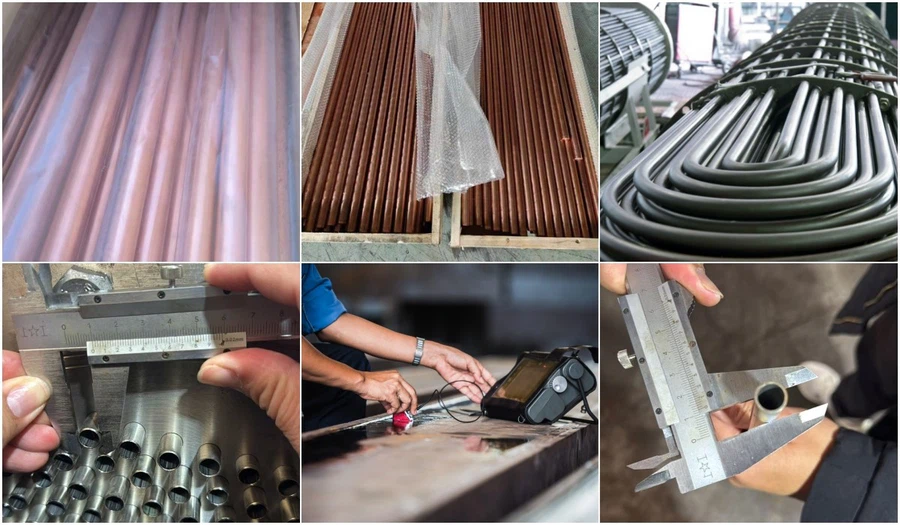
How Do We Package Copper Heat Exchanger Tubes for Global Delivery?
Poor packaging destroys even the best copper heat exchanger tube. As a professional copper heat exchanger tube factory serving copper heat exchanger tube USA, Europe, UAE, Saudi Arabia, and India, we follow military-grade export packaging standards to ensure zero damage during sea or air freight.
Our Standard Packaging Process:
| Packaging Stage | Material / Method | Purpose |
|---|---|---|
| Individual Tube Protection | Anti-rust VCI paper + plastic end caps | Prevents moisture, dust, and scratches on copper tube heat exchanger inner surfaces. |
| Bundling | Nylon straps + wooden spacers | Keeps copper heat exchanger tube OD 19mm, 1 inch, or 5/8 inch sizes organized and vibration-free. |
| Moisture Barrier | Thick PE film wrap (heat-shrunk) | Blocks humidity during long sea voyages to copper heat exchanger tube Germany or Saudi Arabia. |
| Outer Packing | Export-grade plywood cases or steel-banded wooden crates | Withstands stacking and rough handling. Each crate labeled with PO number, alloy (e.g., SB111 C70600), and quantity. |
| Documentation | Packing list + Mill Test Certificate (MTC) attached outside | Customs clearance support for copper heat exchanger tube stockist and distributor partners. |
For U-Bundle Orders: U tube heat exchanger and U tube bundle heat exchanger are placed in dedicated steel jigs inside the crate to prevent bending radius distortion.
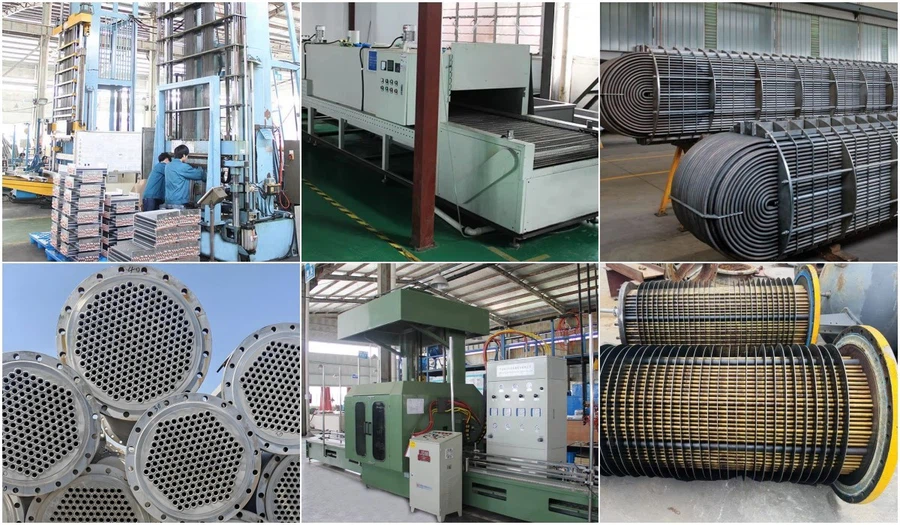
Our Factory & Equipment
| Equipment Type | Specification / Capability | Quality Impact |
|---|---|---|
| Horizontal Continuous Casting Line | 10-ton capacity | Produces homogeneous copper alloy tube for heat exchanger billets with zero porosity. |
| Three-Roll Piercing Mill | Up to 60mm OD | Precision wall thickness control for heat exchanger tube wall thickness as low as 0.5mm. |
| Cold Drawing Bench | 5 draws in sequence | Achieves tight tolerances on copper heat exchanger tube length and heat exchanger pipe diameter. |
| Straightening & Cutting Line | CNC servo-controlled | Burr-free cutting for copper heat exchanger tube 3/4 inch and 1 inch to exact project lengths. |
| U-Bending Machine | CNC mandrel type | Produces u tube condenser and U tube bundle heat exchanger without kinking or ovality. |
| Eddy Current Tester | NDT (Non-Destructive Testing) | 100% inspection of C70600 tube and C71500 tube for pinholes or cracks per ASTM B111 pdf standards. |
| Hydrostatic Tester | Up to 200 bar | Validates heat exchanger tube expansion and tube rolling integrity. |
| Spectrometer | Optical emission (OES) | Confirms chemical composition of ASME SB111, EN 12451, and JIS H3300 grades on every batch. |
Our Certifications & Compliance:
ASTM B111 pdf and ASME SB111 pdf full traceability.
ISO 9001:2015 quality management system.
Third-party inspection accepted: SGS, BV, Lloyds, or TUV.
Copper heat exchanger tube life expectancy testing reports available upon request.
Get Fast Quote & Logistics Plan


