

Chemical Composition
| Element | Percentage (%) |
|---|---|
| Copper (including silver) | > 99.90% |
| Phosphorus | 0.015 – 0.040% |
Equivalent Alloy Specifications
| Specification | Designation |
|---|---|
| UNS | C12200 |
| BSI | C106 |
| ISO | Cu-DHP |
| JIS | C1220 |
ASTM Product Specifications
C12200 tube is covered by a wide range of ASTM specifications depending on the application:
| Specification | Title |
|---|---|
| B5 | High Conductivity Tough Pitch Copper Refinery Shapes |
| B42 | Seamless Copper Pipe, Standard Sizes |
| B68 | Seamless Copper Tube, Bright Annealed |
| B75 | Seamless Copper Tube |
| B88 | Seamless Copper Water Tube |
| B111 | Copper and Copper Alloy Seamless Condenser Tubes and Ferrule Stock |
| B152 | Copper Sheet, Strip, Plate and Rolled Bar |
| B187 | Copper Bar, Bus Bar, Rod and Shapes |
| B280 | Seamless Copper Tube for Air Conditioning and Refrigeration Field Service |
| B302 | Threadless Copper Pipe |
| B306 | Copper Drainage Tube (DWV) |
| B359 | Copper and Copper Alloy Seamless Condenser and Heat Exchanger Tubes With Integral Fins |
| B360 | Hard Drawn Copper Capillary Tube for Restrictor Applications |
| B379 | Phosphorized Coppers – Refinery Shapes |
| B395 | U Bend Seamless Copper and Copper Alloy Heat Exchanger and Condenser Tubes |
| B447 | Welded Copper Tube |
| B543 | Welded Copper and Copper Alloy Heat Exchanger Tube |
| B577 | Detection of Cuprous Oxide (Hydrogen Embrittlement Susceptibility) in Copper |
| B640 | Welded Copper and Copper Alloy Tube for Air Conditioning and Refrigeration Service |
| B698 | Seamless Copper and Copper Alloy Plumbing Pipe and Tube |
| B743 | Seamless Copper Tube in Coils |
| B837 | Seamless Copper Tube for Natural Gas and Liquified Petroleum (LP) Gas Fuel Distribution Systems |
Fabrication Properties
Joining Techniques:
| Joining Technique | Suitability |
|---|---|
| Soldering | Excellent |
| Brazing | Excellent |
| Oxy Acetylene Welding | Good |
| Gas Shielded Arc Welding | Good |
| Coated Metal Arc Welding | Not Recommended |
| Resistance Welding – Spot | Fair |
| Resistance Welding – Seam | Fair |
Fabrication Techniques:
| Fabrication Technique | Suitability |
|---|---|
| Capacity for Being Cold Worked | Excellent |
| Capacity for Being Hot Worked | Good |
| Hot Working Temperature | 750 – 950 °C |
| Annealing Temperature | 250 – 650 °C |
| Stress Relieving Temperature | 200 – 250 °C |
| Machinability Rating | 20% of free cutting brass |
| Polishing/Electroplating Finish | Excellent |
ASTM B111 UNS C12200 Cu-DHP Copper Tubes
C12200, phosphorus deoxidised copper, has been made weldable and brazeable by deoxidising with phosphorus. It is widely used as flat products and tubing, especially where it is to be welded or brazed.
Phosphorus significantly reduces the conductivity, which may go as low as 70% IACS, but also raises the softening temperature when work hardened and promotes fine grain size.
C12200 has almost exactly the same mechanical properties as the high purity copper alloys such as C11000. It has excellent deep drawing characteristics and resistance to pitting corrosion when exposed to severe weather and water environments.
Typical Applications
C12200 tubes are used in a wide variety of applications, including:
Tubes for hot & cold water, gas & heating installations
Soil & waste pipes
Storage tanks, cisterns & cylinders
Rainwater goods, roofing, fascias, building facades
Evaporators
Heat exchangers
Stills, vats, chemical equipment
Anodes for electroplating baths
Physical Properties
| Property | Metric Units | Imperial Units |
|---|---|---|
| Melting Point (Liquidus) | 1083°C | 1981°F |
| Melting Point (Solidus) | 1083°C | 1981°F |
| Density @ 20°C | 8.90 gm/cm³ | 0.321 lb/in³ |
| Specific Gravity | 8.90 | 8.90 |
| Coefficient of Thermal Expansion (20-300°C) | 17.7 × 10⁻⁶ / °C | 9.83 × 10⁻⁶ / °F |
| Thermal Conductivity @ 20°C | 293 – 364 W/m·K | 169 – 211 BTU·ft/ft²·hr·°F |
| Specific Heat (Thermal Capacity) @ 20°C | 385 J/kg·K | 0.092 BTU/lb·°F |
| Electrical Conductivity @ 20°C | 0.41 – 0.52 microhm⁻¹·cm⁻¹ | 70 – 90% IACS |
| Electrical Resistivity @ 20°C | 1.9 – 2.5 microhm·cm | 12 – 15 ohms (circ mil/ft) |
| Modulus of Elasticity (tension) | 115 GPa | 17 × 10⁶ psi |
| Modulus of Rigidity (torsion) | 44 GPa | 6.4 × 10⁶ psi |
| Poisson's Ratio | 0.33 | 0.33 |
Corrosion Resistance
C12200 has similar corrosion resistance to C11000. It gives excellent resistance to weathering and very good resistance to many chemicals. It is often used specifically for corrosion resistance.
It is suitable for use with most waters, and can be used underground because it resists soil corrosion. It resists non-oxidising mineral and organic acids, caustic solutions, and saline solutions.
Depending on concentration and specific conditions of exposure, copper generally resists:
Acids: Mineral acids such as hydrochloric and sulphuric acids; organic acids such as acetic acid (including acetates and vinegar), carbolic, citric, formic, oxalic, tartaric and fatty acids; acidic solutions containing sulphur, such as the sulphurous acid and sulphite solutions used in pulp mills.
Alkalies: Fused sodium and potassium hydroxide; concentrated and dilute caustic solutions.
Salt solutions: Aluminium chloride, aluminium sulphate, calcium chloride, copper sulphate, sodium carbonate, sodium nitrate, sodium sulphate, zinc sulphate.
Waters: All potable waters, many industrial and mine waters, seawater and brackish water.
The corrosion resistance of C12200 is NOT adequate for:
Ammonia, amines and ammonium salts
Oxidizing acids such as chromic and nitric acids and their salts
Ferric chloride
Persulphates and perchlorates
Mercury and mercury salts
FAQ
Q1: What is the difference between C12200 and C11000 copper?
A: C12200 is phosphorus deoxidized copper (0.015-0.040% P). C11000 is electrolytic tough pitch copper (high purity, no deoxidizer). C12200 is weldable and brazeable; C11000 can suffer hydrogen embrittlement when welded. C12200 has slightly lower electrical conductivity (70-90% IACS vs 100%+ for C11000) but similar mechanical properties.
Q2: Why does phosphorus reduce conductivity in C12200?
A: Phosphorus atoms in solid solution scatter electrons, reducing electrical and thermal conductivity. C12200 conductivity ranges from 70-90% IACS compared to 100%+ for pure copper. However, the trade-off is improved weldability and higher softening temperature.
Q3: Can C12200 be used in seawater applications?
A: Yes, with caution. The corrosion resistance table above lists seawater as a suitable medium. However, for high-velocity seawater or long-term immersion, cupronickel alloys (C70600, C71500) are typically preferred. C12200 is more commonly used for fresh water, plumbing, and HVAC.
Q4: What is the maximum operating temperature for C12200?
A: For continuous service, up to about 200°C (400°F). Above this temperature, strength decreases rapidly. Short-term exposure to higher temperatures may be acceptable depending on stress levels. For higher temperature applications, consider other copper alloys or stainless steel.
Q5: How to weld C12200 copper tube?
A: C12200 is weldable by gas shielded arc welding (TIG) and oxy-acetylene welding. Use deoxidized filler rod (ERCu). Clean the tube thoroughly before welding. No preheating is required for thin walls. The phosphorus content prevents hydrogen embrittlement.
Q6: What is the annealing temperature range for C12200?
A: 250-650°C (482-1202°F). The exact temperature depends on the degree of annealing required and prior cold work. Lower temperatures (250-400°C) provide stress relief. Higher temperatures (500-650°C) produce full annealing with recrystallization.
Q7: Is C12200 suitable for underground service?
A: Yes. The corrosion resistance section notes that C12200 resists soil corrosion and can be used underground. However, local soil conditions vary. In aggressive soils, additional protection (wrapping or coating) may be advisable.
Q8: What is the machinability rating of C12200?
A: 20% of free cutting brass. C12200 is gummy and tends to form long chips. Sharp tools, positive rake angles, and appropriate cutting fluids are recommended. For extensive machining, consider leaded copper alloys.
Q9: Which ASTM specifications cover C12200 heat exchanger tubes?
A: ASTM B111 (Seamless Condenser Tubes) is the primary specification. ASTM B395 covers U-bend tubes. ASTM B359 covers tubes with integral fins. ASTM B543 covers welded heat exchanger tubes.
Q10: Does C12200 resist ammonia?
A: No. Ammonia, amines, and ammonium salts are listed as media where C12200 corrosion resistance is NOT adequate. Avoid using C12200 in contact with ammonia or ammonium compounds, which can cause stress corrosion cracking.
How Do We Package Copper Heat Exchanger Tubes for Global Delivery?
Poor packaging destroys even the best copper heat exchanger tube. As a professional copper heat exchanger tube factory serving copper heat exchanger tube USA, Europe, UAE, Saudi Arabia, and India, we follow military-grade export packaging standards to ensure zero damage during sea or air freight.
Our Standard Packaging Process:
| Packaging Stage | Material / Method | Purpose |
|---|---|---|
| Individual Tube Protection | Anti-rust VCI paper + plastic end caps | Prevents moisture, dust, and scratches on copper tube heat exchanger inner surfaces. |
| Bundling | Nylon straps + wooden spacers | Keeps copper heat exchanger tube OD 19mm, 1 inch, or 5/8 inch sizes organized and vibration-free. |
| Moisture Barrier | Thick PE film wrap (heat-shrunk) | Blocks humidity during long sea voyages to copper heat exchanger tube Germany or Saudi Arabia. |
| Outer Packing | Export-grade plywood cases or steel-banded wooden crates | Withstands stacking and rough handling. Each crate labeled with PO number, alloy (e.g., SB111 C70600), and quantity. |
| Documentation | Packing list + Mill Test Certificate (MTC) attached outside | Customs clearance support for copper heat exchanger tube stockist and distributor partners. |
For U-Bundle Orders: U tube heat exchanger and U tube bundle heat exchanger are placed in dedicated steel jigs inside the crate to prevent bending radius distortion.
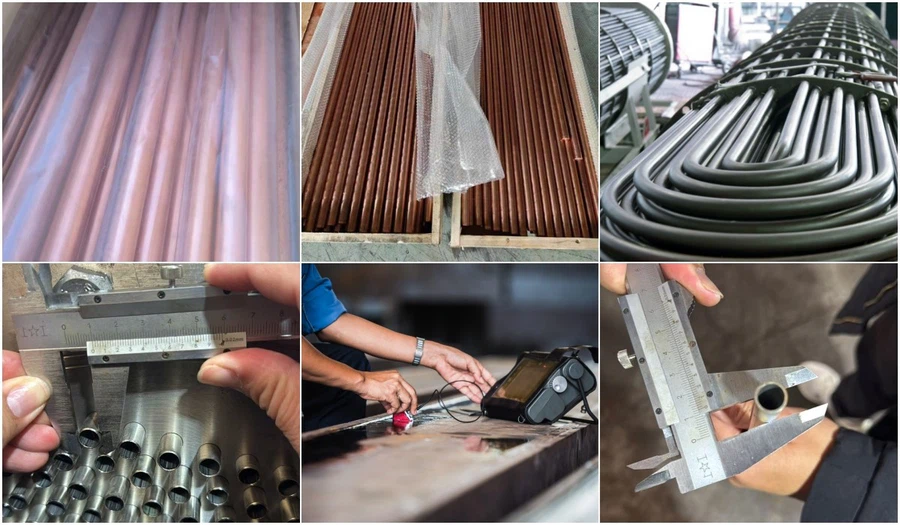
Our Factory & Equipment
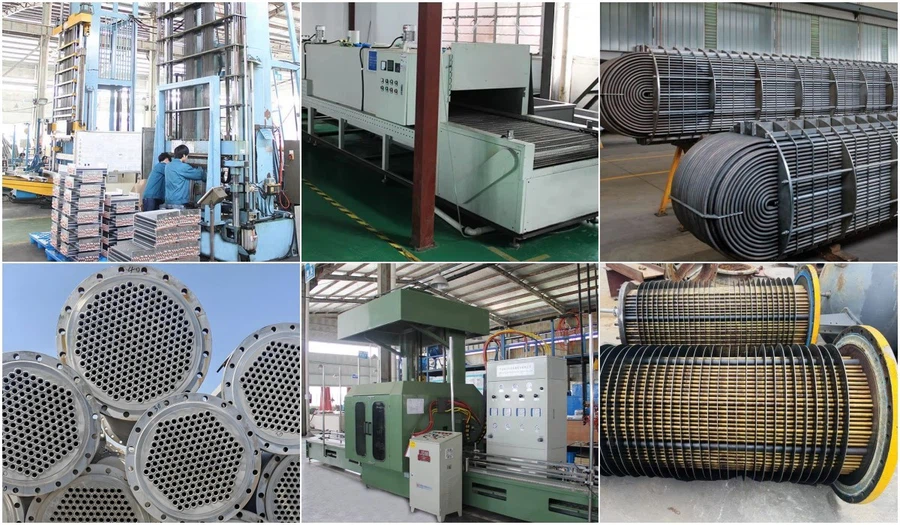
| Equipment Type | Specification / Capability | Quality Impact |
|---|---|---|
| Horizontal Continuous Casting Line | 10-ton capacity | Produces homogeneous copper alloy tube for heat exchanger billets with zero porosity. |
| Three-Roll Piercing Mill | Up to 60mm OD | Precision wall thickness control for heat exchanger tube wall thickness as low as 0.5mm. |
| Cold Drawing Bench | 5 draws in sequence | Achieves tight tolerances on copper heat exchanger tube length and heat exchanger pipe diameter. |
| Straightening & Cutting Line | CNC servo-controlled | Burr-free cutting for copper heat exchanger tube 3/4 inch and 1 inch to exact project lengths. |
| U-Bending Machine | CNC mandrel type | Produces u tube condenser and U tube bundle heat exchanger without kinking or ovality. |
| Eddy Current Tester | NDT (Non-Destructive Testing) | 100% inspection of C70600 tube and C71500 tube for pinholes or cracks per ASTM B111 pdf standards. |
| Hydrostatic Tester | Up to 200 bar | Validates heat exchanger tube expansion and tube rolling integrity. |
| Spectrometer | Optical emission (OES) | Confirms chemical composition of ASME SB111, EN 12451, and JIS H3300 grades on every batch. |
Our Certifications & Compliance:
ASTM B111 pdf and ASME SB111 pdf full traceability.
ISO 9001:2015 quality management system.
Third-party inspection accepted: SGS, BV, Lloyds, or TUV.
Copper heat exchanger tube life expectancy testing reports available upon request.
Get Fast Quote & Logistics Plan


