

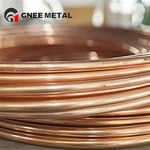
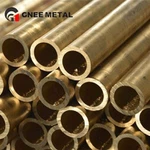
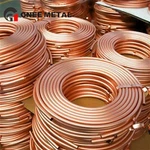
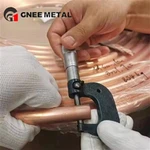


Copper Electrical Busbar
Thickness: 3mm – 30mm
Width: 10mm – 200mm
Length: Up to 6,000mm (custom cut available)
Temper: Hard, half-hard, or annealed
Surface Finish: Bare, tin-plated, silver-plated, or nickel-plated
Conductivity: ≥ 101% IACS
Custom Options: Hole punching, bending, cutting to size
Standards: ASTM B187, BS EN 13601
Henan Gnee New Material Co., Ltd. is one of the most professional manufacturers and suppliers of copper electrical busbar in China, specialized in providing high quality copper products with competitive price. Welcome to buy discount copper electrical busbar for sale here from our factory. Customized orders are welcome.
What Is a Copper Electrical Busbar?
A copper electrical busbar is a solid or laminated conductive strip, typically made of C11000 ETP (Electrolytic Tough Pitch) copper with a purity of 99.9%. It serves as a central power distribution point inside switchgear, panel boards, and substations, replacing multiple cables to reduce wiring complexity and heat generation.
| Parameter | Value |
|---|---|
| Material Grade | C11000 (also known as ETP Cu / Cu-ETP / ASTM B187) |
| Purity | ≥99.9% |
| Conductivity | 100% IACS (≥58 MS/m) |
| Standards | ASTM B187, IEC 60143, BS EN 13601, GB/T 5585 |
| Temper | Half-hard (H02) or Hard (H04) as required |
| Available Length | Up to 4 meters (longer upon request) |

A proper copper busbar used in electrical panels and switchgear must meet IEC 61439 creepage and clearance requirements. Mill test certificates (MTC) are included with every shipment.
Why Choose Copper Busbar?
Copper remains the global standard for high-current busbars. The table below compares copper vs. aluminum across decision-critical factors.
Copper vs. Aluminum Busbar – Technical Comparison
| Property | Copper Busbar (C11000) | Aluminum Busbar (6061) | Why It Matters for Your Project |
|---|---|---|---|
| Electrical Conductivity (% IACS) | 100% (≥58 MS/m) | ~61% | Copper carries the same current with smaller cross-section – saves panel space |
| Thermal Conductivity (W/m·K) | ~401 | ~235 | Better heat dissipation of copper busbar – reduces hot spots in enclosed switchgear |
| Mechanical Strength (MPa) | 200–250 | ~90 | Resists creep and loosening over thermal cycles – fewer re-torquing events |
| Oxide Layer Behavior | Conductive | Non-conductive (requires grease) | Copper oxide does not increase contact resistance – more reliable long-term |
| Typical Lifespan | 25–50+ years | 15–25 years | Lower maintenance of copper busbars over the system lifetime |
Copper Busbar Shapes
The importance of busbar shape directly affects current carrying capacity and heat dissipation. Choose based on your panel's mechanical and thermal constraints.

Flat Copper Busbar (Most Common)
Best for: High-heat-load environments (switchgear, MCCs)
Advantage: Large surface area maximizes heat dissipation of copper busbar
Typical ratio: Width : Thickness = 5:1 to 10:1
Rectangular & Round Edge Busbars
Best for: High-vibration applications (EV charging, marine)
Advantage: Reduced corona effect at higher voltages (>600V)

Custom-Shaped Copper Busbars
Best for: Space-constrained retrofit panels or complex power paths
Examples: L-bends, Z-bends, multi-layer laminated flexible busbars
Selection tip: For the same cross-sectional area, flat busbars vs round busbars – flat offers 15–25% better cooling, while round provides better mechanical rigidity.
Copper Busbar Stamping and Hole Punching
Many customers require copper busbars with pre-punched holes for direct bolt connection to circuit breakers, switches, or transformers. We provide copper busbar stamping and CNC machining for all custom hole patterns.

Standard Hole Options
| Hole Type | Diameter Range | Tolerance | Best For |
|---|---|---|---|
| Round holes | 4mm – 20mm | ±0.1mm | Standard bolt connections (M4 to M20) |
| Slotted holes | 6mm x 12mm to 10mm x 25mm | ±0.15mm | Thermal expansion compensation, adjustable mounting |
| Counterbored holes | Custom sizes | ±0.1mm | Flush mounting where bolt head must not protrude |
| Threaded holes | M4 – M12 | 6H tolerance | Direct screw attachment without nuts |
Applications of Copper Busbars in Electrical Systems
Based on field data from over 200 projects, the applications of copper busbars in power distribution include:

Typical Applications by Industry and Current Range
| Industry / Application | Typical Current Range | Why Copper Busbar Is Chosen |
|---|---|---|
| Data Center Busways & PDUs | 400A – 5000A | Compact design & low heat – no cooling derating |
| Solar Combiner Boxes & Inverters | 200A – 1600A | Corrosion resistance & high ambient temp tolerance |
| EV Charging Stations (DC Fast) | 250A – 800A | Laminated flexible busbars for vibration & thermal cycling |
| Switchgear & Motor Control Centers | 800A – 6300A | High current carrying capacity of copper busbar with safe creepage |
| Substation Grounding Grids | N/A (fault current) | Low impedance for copper busbars for grounding and bonding |
Current Carrying Capacity of Copper Busbar
The current carrying capacity of copper busbar is the most critical parameter for panel designers. The table below shows ampacity for bare C11000 copper busbars under standard conditions (35°C ambient, 65°C max operating temperature, AC 50/60Hz, based on IEC 61439 derating guidelines).
Ampacity of Flat Copper Busbar – Common Sizes
| Width (mm) | Thickness (mm) | Cross-section (mm²) | Current Carrying Capacity (Amps) |
|---|---|---|---|
| 20 | 3 | 60 | 180 A |
| 20 | 5 | 100 | 250 A |
| 25 | 6 | 150 | 350 A |
| 30 | 5 | 150 | 370 A |
| 30 | 6 | 180 | 410 A |
| 40 | 5 | 200 | 460 A |
| 40 | 6 | 240 | 520 A |
| 50 | 5 | 250 | 550 A |
| 50 | 6 | 300 | 620 A |
| 60 | 6 | 360 | 720 A |
| 60 | 10 | 600 | 1050 A |
| 80 | 6 | 480 | 900 A |
| 80 | 10 | 800 | 1350 A |
| 100 | 10 | 1000 | 1600 A |
This ampacity table is based on ASTM B187 and IEC 61439 standards for copper busbar used in electrical panels and switchgear. For ambient temperatures above 35°C, multiply by 0.88 (45°C) or 0.76 (55°C). For DC applications, current carrying capacity of copper busbar is approximately 5-8% higher.
Need a non-standard size? We provide copper busbar specifications and sizing for any cross-section up to 1200mm².
Contact us for a custom calculation
Tinned Copper Busbars for Corrosion Resistance
To enhance corrosion resistance, contact performance, and electrical safety, we offer three standard plating options plus heat shrink insulation. Tinned copper busbars for corrosion resistance are the most common choice for indoor switchgear. Proper tin plating / silver plating / nickel coating for copper busbars can extend service life by 2-3x in harsh environments. For additional protection, we also provide colored heat shrink tubing for insulation, touch-proof safety, and phase identification.

Plating & Insulation Options for Copper Busbars
| Surface Treatment | Thickness / Spec | Key Benefit | Typical Application |
|---|---|---|---|
| Tin Plating | 3-8 microns | Low cost, good corrosion resistance | Standard switchgear, panel boards |
| Silver Plating | 5-15 microns | Lowest contact resistance, high conductivity | High-frequency, EV connectors, military |
| Nickel Plating | 3-10 microns | Excellent wear resistance, high temp stability | High-temperature environments (>150°C) |
| Heat Shrink Tubing | 1.5x – 3x shrink ratio | Electrical insulation, touch-proof safety, color-coded (red/black/blue/yellow/green) | Insulated copper busbar systems, data centers, EV battery packs |
For copper busbars for grounding and bonding, tin plating is sufficient. For copper busbars for data centers and server rooms, we recommend silver plating + heat shrink tubing for lowest contact resistance and touch-proof safety. For high-voltage switchgear (>600V), PVC or epoxy insulation is available upon request.
Quality Testing and Inspection for Copper Busbars

| Test Item | Equipment | Acceptance Standard | Frequency |
|---|---|---|---|
| Conductivity | Eddy current sigmascope | ≥58 MS/m (100% IACS) | Every batch |
| Dimensional check | CMM / calipers | ±0.1mm (width/thickness), ±0.5mm (length) | 100% |
| Hardness | Rockwell / Vickers | HV 60-85 (half-hard) | Every batch |
| Salt spray (corrosion) | ASTM B117 chamber | Tin-plated:≥96h no red rust | Weekly |
| Heat rise (ΔT) | Thermal imager + load bank | ΔT ≤ 35K at rated current | Sample basis |
These tests ensure that every copper busbar installation practices requirement is met for quality consistency. Third-party testing (SGS, TÜV) is available upon request at additional cost.
Packaging of Copper Busbars for Export

Interleaving: Kraft paper + foam sheet between each busbar layer
Moisture protection: VCI (vapor corrosion inhibitor) film wrapped around bundles
Bundling: Steel straps on wooden pallets (heat-treated, IPPC certified)
Labeling: Material grade (C11000), PO number, dimensions, plating type, quantity
Extra protection for flexible busbars: Cardboard edge protectors + individual poly bags
Container loading: Max 24 pallets per 20GP container (approx. 18-22 tons of copper busbars).
Copper Busbar Stamping and CNC Machining

Production process:
Raw material cutting – CNC shearing to ±0.1mm
Hole punching / stamping – CNC turret press (hole tolerance ±0.1mm)
Edge deburring & radius rolling – removes sharp edges
Bending / forming – CNC press brake (angle tolerance ±1°)
Plating (optional) – in-house tin/silver/nickel plating line
Final inspection – 100% dimensional + conductivity check
Lead times:
| Order Type | Lead Time |
|---|---|
| Sample (standard size, no plating) | 5-7 business days |
| Sample (custom size/dimensions) | 7-10 business days |
| Production order (standard, no plating) | 10-15 business days |
| Production order (with tin/silver plating) | 15-20 business days |
| Flexible or laminated copper busbars for vibration-prone environments | 20-25 business days |
First-time customers can request one free copper busbar sample (length ≤ 300mm, standard cross-section). You only pay for shipping.
Click here to request your sample now
FAQ
Q1:What is the minimum order quantity (MOQ) for copper busbars?
MOQ = 10 pieces for standard sizes from our die library. MOQ = 50 pieces for custom-shaped copper busbars (L-bends, Z-bends, special hole patterns). For flexible or laminated copper busbars for vibration-prone environments, MOQ = 30 pieces.
No MOQ for sample orders. We support small-batch prototypes before mass production.
Q2:Do you offer samples? What is your sample policy?
Yes, we offer samples for all copper busbar types.
| Sample Type | Cost | Shipping | Refund Policy |
|---|---|---|---|
| Standard size (from stock) | Free | Customer pays | N/A |
| Custom size / plating / bending | 50 USD | Customer pays | Refundable upon order of 500+ pieces |
Sample lead time: 5-7 business days for standard sizes, 7-10 business days for custom sizes.
Q3:What are your standard copper busbar sizes?
Width:10mm to 220mm | Thickness:3mm to 30mm | Length:up to 4 meters (longer available with splice kit)
Refer to our copper busbar specifications and sizing ampacity table above for current ratings.
Q4:How long do copper busbars last?
Indoor, controlled environment:30-50 years. Harsh or coastal environment with tin plating:20-30 years.
This is why copper busbar longevity 25 to 50 years is a key selection criterion for utilities, data centers, and industrial facilities.
Q5:Can you provide stamped or bent copper busbars with holes?
Yes. We provide copper busbar stamping and CNC machining with:
Hole tolerance:±0.1mm
Bend tolerance:±1°
Maximum bending length:up to 600mm
Send your drawing in PDF, DWG, or DXF format for a quick quote.
Q6:Which certifications do your copper busbars carry?
RoHS and REACH compliant
CE (LVD) certified
UL file under application
Third-party test reports (SGS, TÜV) available at additional cost
Mill test certificates (MTC) are included free with every shipment.
Q7:Do you provide insulated copper busbars?
Yes. We offer three insulation options:
| Insulation Type | Voltage Rating | Best For |
|---|---|---|
| Heat shrink tubing (color-coded) | Up to 15kV | Insulated copper busbar systems, data centers, EV battery packs |
| Epoxy powder coating | Up to 36kV | High-voltage switchgear, outdoor substations |
| PVC sleeving | Up to 600V | Basic touch-proof protection for low-voltage panels |
For copper busbars for data centers and server rooms, we recommend silver plating + heat shrink tubing for lowest contact resistance and touch-proof safety.
Q8:What is the difference between C11000 and C10100 copper?
| Grade | Purity | Best For |
|---|---|---|
| C11000 (ETP) | 99.9% | Standard copper busbar used in electrical panels and switchgear – cost effective |
| C10100 (OFE) | 99.99% | High-vacuum, extreme conductivity, or sensitive electronic applications |
For 99% of busbar applications, C11000 is sufficient and recommended.
Q9:Do you provide copper busbars for grounding and bonding?
Yes. Copper busbars for grounding and bonding are available in standard and custom sizes. We recommend tin plating for grounding applications in humid or outdoor environments.
Q10:Do you provide copper busbars for solar power plants?
Yes. Copper busbars for solar power plants require high corrosion resistance for outdoor exposure. We recommend:
Tin or silver plating for corrosion protection
UV-resistant heat shrink for insulation
High ampacity ratings for DC applications (5-8% higher than AC)
Q11:Do you ship internationally?
Yes. We ship worldwide via sea freight, air freight, or express courier (DHL, FedEx, UPS). Typical shipping destinations include:
North America (USA, Canada, Mexico)
Europe (Germany, UK, France, Italy, Spain, Poland)
Asia (Japan, South Korea, India, Vietnam, Thailand)
Middle East (UAE, Saudi Arabia, Israel)
Australia and New Zealand
For tinned copper busbars for corrosion resistance, we add VCI film and foam interleaving to prevent oxidation during long sea shipments.
Hot Tags: copper electrical busbar, China copper electrical busbar manufacturers, suppliers, factory, copper
Previous
No InformationNext
No InformationYou Might Also Like


Send Inquiry