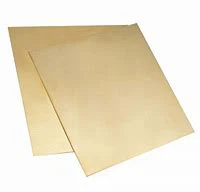
C26800 Composition
C26800 brass comprises 66% copper and 34% zinc, with small amounts of lead, iron, and tin. Zinc in this alloy gives it excellent corrosion resistance while adding information improves machinability. However, the high lead content makes it unsuitable for welding or soldering.
| Element | Content(%) |
|---|---|
| Iron, Fe | ≤ 0.050 |
| Lead, Pb | ≤ 0.15 |
| Zinc, Zn | 31.3 – 36.0 |
| Copper, Cu | 65.0 |
C26800 Physical Properties
C26800 brass has a density of 8.53 g/cm³, a melting point of 889-905 °C, and a thermal conductivity of 121 W/m.K. This alloy is non-magnetic, has low conductivity, and is easily malleable. C26800 brass also exhibits a bright, yellowish-gold colour, which makes it an appealing material for decorative purposes.
| Properties | Metric | Imperial |
|---|---|---|
| Density | 8.47 g/cm3 | 0.306 lb/in3 |
| Melting point | 904°C | 1660°F |
C26800 Mechanical Properties
C26800 brass is a malleable alloy with excellent ductility and cold-working properties, making it easy to form into different shapes. It also has good tensile and yield strength, making it durable and long-lasting.
C26800 Uses
C26800 brass is commonly used for plumbing fixtures, electrical components, decorative hardware, and automotive parts. Its excellent corrosion resistance and malleability make it a popular material for plumbing fixtures such as valves, faucets, and pipe fittings. Its conductivity makes it ideal for electrical components such as switchgear, bus bars, and connectors. Its decorative finish enhances its use in door and window hardware, locks, and lighting fixtures.
C26800 Hardness
C26800 brass has a moderate hardness with a Rockwell B score of 79, making it easy to work using standard machining processes. Its softness and malleability allow it to be formed into intricate shapes without cracking or breaking.
C26800 Brass Heat Treatment
C26800 brass can be heat treated to improve its mechanical properties and hardness. This is achieved through a process known as annealing, which involves heating the alloy to a temperature of 700-900 °C, followed by quenching in water.
C26800 Brass Welding
Welding C26800 brass is challenging due to its high lead content, which can lead to brittleness and cracks in the weld. However, it can be welded using brazing techniques with suitable filler metals that match the composition of the alloy.
C26800 Brass Corrosion Resistance
C26800 brass exhibits excellent resistance to corrosion, especially in seawater and marine environments. The addition of zinc to the alloy creates a protective layer that prevents rust and corrosion. This property is ideal for marine and offshore applications with high moisture and saltwater exposure.