

When you order 10 kilometers of C70600 tube for a power plant condenser, the weight determines your freight cost. A few extra grams per meter adds up to tons. When you design a pipe support on an offshore platform, the weight tells you how strong the support needs to be. When you estimate project cost, weight (not length) is what suppliers use to calculate price. Getting the weight wrong means wrong freight budget, wrong supports, and wrong cost.
C70600 density is 8.94 g/cm³. Use that number and the formulas below to calculate weight for any tube size.
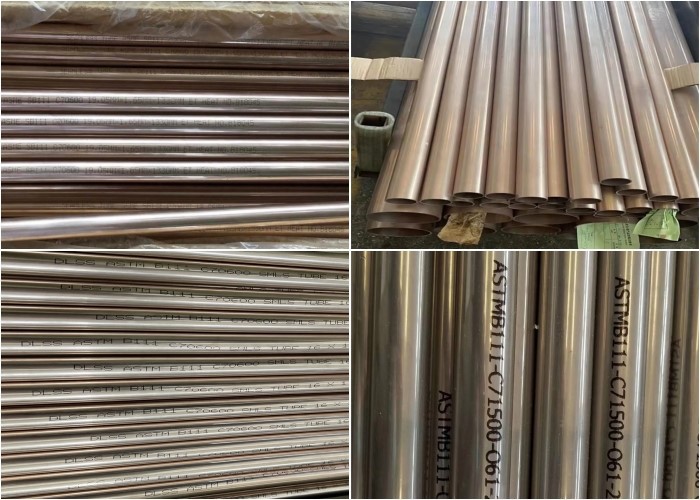
What is the exact weight of C70600 tube per meter for common sizes?
The table below shows weight per meter and weight per foot for standard ASTM B111 C70600 tube sizes. Use this for quick estimates.
| OD (inch) | OD (mm) | BWG | Wall (mm) | Weight (kg/m) | Weight (lb/ft) |
|---|---|---|---|---|---|
| 1/4" | 6.35 | BWG 20 | 0.89 | 0.121 | 0.081 |
| 1/4" | 6.35 | BWG 18 | 1.24 | 0.141 | 0.095 |
| 3/8" | 9.53 | BWG 20 | 0.89 | 0.191 | 0.128 |
| 3/8" | 9.53 | BWG 18 | 1.24 | 0.229 | 0.154 |
| 1/2" | 12.70 | BWG 20 | 0.89 | 0.262 | 0.176 |
| 1/2" | 12.70 | BWG 18 | 1.24 | 0.317 | 0.213 |
| 1/2" | 12.70 | BWG 16 | 1.65 | 0.400 | 0.269 |
| 5/8" | 15.88 | BWG 20 | 0.89 | 0.332 | 0.223 |
| 5/8" | 15.88 | BWG 18 | 1.24 | 0.405 | 0.272 |
| 5/8" | 15.88 | BWG 16 | 1.65 | 0.516 | 0.347 |
| 3/4" | 19.05 | BWG 18 | 1.24 | 0.492 | 0.331 |
| 3/4" | 19.05 | BWG 16 | 1.65 | 0.630 | 0.423 |
| 3/4" | 19.05 | BWG 14 | 2.11 | 0.782 | 0.525 |
| 7/8" | 22.23 | BWG 18 | 1.24 | 0.580 | 0.390 |
| 7/8" | 22.23 | BWG 16 | 1.65 | 0.745 | 0.501 |
| 1" | 25.40 | BWG 18 | 1.24 | 0.668 | 0.449 |
| 1" | 25.40 | BWG 16 | 1.65 | 0.862 | 0.579 |
| 1" | 25.40 | BWG 14 | 2.11 | 1.080 | 0.726 |
| 1-1/4" | 31.75 | BWG 16 | 1.65 | 1.094 | 0.735 |
| 1-1/4" | 31.75 | BWG 14 | 2.11 | 1.384 | 0.930 |
| 1-1/2" | 38.10 | BWG 14 | 2.11 | 1.676 | 1.126 |
| 1-1/2" | 38.10 | BWG 12 | 2.77 | 2.160 | 1.452 |
| 2" | 50.80 | BWG 14 | 2.11 | 2.264 | 1.521 |
| 2" | 50.80 | BWG 12 | 2.77 | 2.972 | 1.997 |
How do you calculate C70600 tube weight for any size?
Use this formula: Weight (kg/m) = (OD² - ID²) x π/4 x density ÷ 1,000,000
Where:
OD and ID are in mm
π/4 = 0.7854
Density = 8.94 g/cm³
Divide by 1,000,000 to convert from g/mm³ to kg/m
Simplified formula:
Weight (kg/m) = 0.00702 x (OD² - ID²)
ID = OD - (2 x wall thickness)
Example calculation:
For 3/4" OD (19.05mm) x BWG 18 (1.24mm wall):
ID = 19.05 - (2 x 1.24) = 16.57mm
OD² = 19.05 x 19.05 = 362.9
ID² = 16.57 x 16.57 = 274.6
OD² - ID² = 88.3
Weight = 0.00702 x 88.3 = 0.620 kg/m
Where do you actually need C70600 tube weight data?
Freight and logistics
Sea freight: container weight limits (typically 22-25 tons per 20ft container)
Air freight: charged by actual or dimensional weight
Trucking: axle weight limits on roads
Lifting: crane capacity for tube bundles
Structural design
Pipe support spacing based on tube weight + fluid weight
Vibration analysis (heavier tubes have different natural frequencies)
Offshore platform deck loading
Cost estimation
Most tube pricing is per kg, not per meter
Total weight x price per kg = material cost
Weight also affects welding consumables and labor
Know the weight of your tube order before you book freight or design supports. A 10% error in weight can break both your budget and your structure.
How much does a full container of C70600 tube weigh?
A standard 20ft container holds about 22-25 tons of C70600 tube, depending on tube size and packaging. Smaller tubes pack tighter and weigh more per container. Larger tubes leave more empty space.
Typical container loads:
| Tube size | 20ft container (tons) | 40ft container (tons) |
|---|---|---|
| 1/2" OD x BWG 18 | 24-25 tons | 22-23 tons (volume limited) |
| 3/4" OD x BWG 18 | 24-25 tons | 22-23 tons |
| 1" OD x BWG 16 | 23-24 tons | 21-22 tons |
| 1-1/2" OD x BWG 14 | 22-23 tons | 20-21 tons |
| 2" OD x BWG 14 | 20-21 tons | 18-19 tons |
Always confirm with your freight forwarder. Some ports have weight limits per container. Overweight containers get rejected at loading or incur extra fees.
How do C70600 tube weights compare to other materials?
C70600 is about the same weight as pure copper and much heavier than aluminum or titanium. Here is a density comparison.
| Material | Density (g/cm³) | Weight relative to C70600 |
|---|---|---|
| C11000 copper | 8.96 | 1.00x (same) |
| C70600 | 8.94 | 1.00x (baseline) |
| C71500 | 8.94 | 1.00x |
| 316L stainless | 7.98 | 0.89x (lighter) |
| Titanium Grade 2 | 4.51 | 0.50x (much lighter) |
| Aluminum 6061 | 2.70 | 0.30x (lightest) |
What this means for your project:
Replacing C12200 copper with C70600? Weight is the same.
Replacing 316L stainless with C70600? You add about 12% weight.
Replacing titanium with C70600? You double the weight for the same wall thickness.
FAQ
Q1: What is the density of C70600 copper nickel?
8.94 g/cm³ (0.323 lb/in³). This is the number you need for all weight calculations. It is slightly higher than water (1.0). A 1 meter length of 3/4" OD x BWG 18 tube weighs about 0.5 kg. A 6 meter stick weighs about 3 kg. Use the chart above for quick lookup.
Q2: How do I calculate total weight for a large tube order?
Multiply weight per meter by total meters. Then add 5-10% for packaging if freight is paid by weight. Example: 10,000 meters of 3/4" OD x BWG 18 tube at 0.492 kg/m = 4,920 kg (4.92 tons). Packaging adds about 250-500 kg. Ask your supplier for the exact shipping weight before booking freight.
Q3: Does tube weight include the weight of end caps and packaging?
Weight per meter in the chart is tube only. Packaging adds extra weight. Plastic end caps add 10-50 grams per tube. Wooden cases add 50-200 kg per bundle. For large orders, packaging can be 5-10% of total shipping weight. If you are near a weight limit (e.g., 25 tons per container), ask your supplier for a shipping weight that includes packaging.
Q4: Why is my calculated weight different from the supplier's weight?
Small differences come from rounding, actual wall thickness (tolerance ±10%), and density assumption (some use 8.9, some use 8.94). If the difference is under 5%, it is normal. If it is over 10%, ask for the actual measured weight from the mill. Some suppliers estimate weight per meter based on nominal dimensions. Actual weight may vary.
Q5: How much does a 20ft container of C70600 tube weigh?
Typically 22-25 tons for common heat exchanger sizes. The exact weight depends on tube OD, wall thickness, and how tightly tubes pack. Small ODs (1/2") pack tighter and reach weight limit before volume limit. Large ODs (2"+) hit volume limit before weight limit. Always ask your supplier for the estimated container weight before shipping.
Q6: Is C70600 heavier than 316L stainless steel?
Yes, about 12% heavier for the same dimensions. C70600 density is 8.94 g/cm³. 316L density is 7.98 g/cm³. If you replace 316L tube with C70600 tube of the same OD and wall, the C70600 tube will weigh about 12% more. This matters for weight‑sensitive applications like offshore platforms or shipboard systems.
Q7: What is the weight of a single 6m C70600 tube?
For 3/4" OD x BWG 18: about 2.95 kg (6.5 lb). Weight per meter is 0.492 kg. Multiply by 6 = 2.95 kg. For a bundle of 100 tubes (6m each), total tube weight = 295 kg. Add packaging (about 15-20 kg) and you are around 315 kg. Hand carry is not possible. Use a forklift or pallet jack.
Q8: Does the weight chart work for C71500 tube too?
Yes, because C70600 and C71500 have nearly identical density (8.94 vs 8.94 g/cm³). Use the same chart for both grades. The weight difference between the two alloys is less than 0.1%. For practical purposes, they are the same. Do not create separate weight charts for C70600 and C71500. One chart works for both.
Q9: How do I convert tube weight from kg/m to lb/ft?
Multiply kg/m by 0.672 to get lb/ft. Example: 0.492 kg/m x 0.672 = 0.331 lb/ft. The table above includes lb/ft for common sizes. For non‑standard sizes, calculate in kg/m first, then convert. Do not reverse the conversion by accident. 1 kg/m = 0.672 lb/ft. 1 lb/ft = 1.488 kg/m.
Q10: How much weight does a tube lose after 20 years of seawater corrosion?
Very little. Uniform corrosion removes about 0.025 mm per year. After 20 years, wall loss is about 0.5mm. For a 1.24mm wall tube, that is 40% of the wall thickness. For a 1.65mm wall tube, it is 30%. Weight loss is proportional to wall loss. A 3/4" OD x BWG 18 tube (0.492 kg/m) loses about 0.015 kg/m over 20 years. Not significant for freight, but significant for pressure rating.
Our Testing
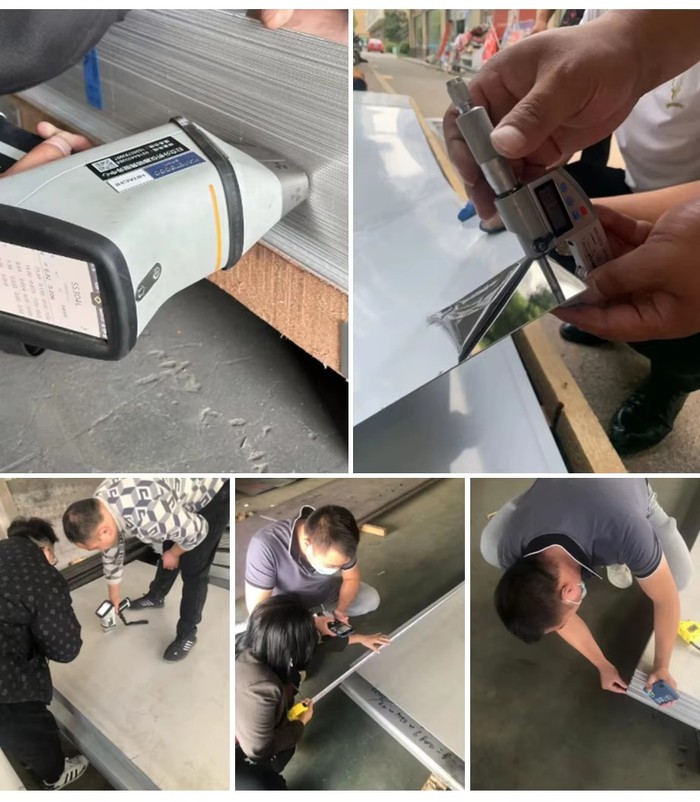
Chemistry (spectrometer, ASTM E1473) → Ni 9-11%, Fe 1.0-1.8%
Tensile (pull to break, ASTM E8) → 310 MPa minimum
Flatten (squeeze ring to 3x wall, ASTM B968) → no cracks
Flare (30° cone expansion, ASTM B969) → no splits
Eddy current (100% of tubes, ASTM E243) → reject any signal
What you get
Mill Test Report (MTR) with every order
Traceable by heat number
Third party inspection available (SGS, BV, Lloyds)
Our Packaging
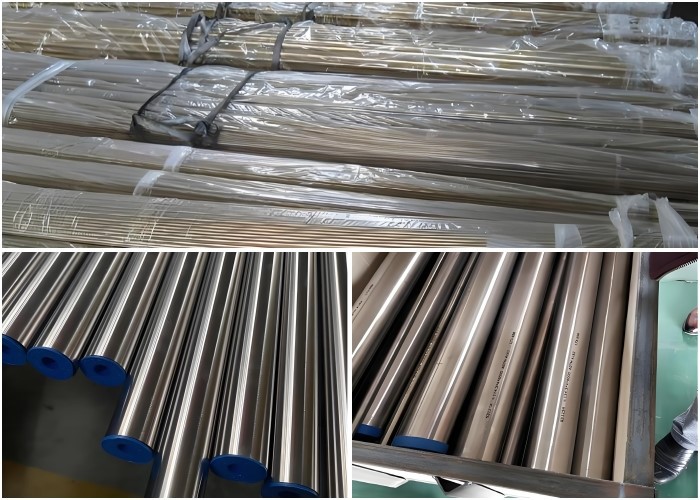
tube
Plastic cap on both ends
VCI paper inside (upon request)
bundle
Shrink wrapped (seals out moisture)
Steel strapped (4-6 straps)
Wooden case for fragile sizes
Pallet + steel for standard 6m
label
Grade (C70600 / 90/10)
Size (OD x BWG)
Heat number (traceable)
Quantity and length
Our Factory Equipment
| Station | Equipment | What we make |
|---|---|---|
| 1 | Melting furnace (3x, 5 tons) | Liquid copper nickel alloy |
| 2 | Continuous caster (2 lines) | Solid billet 80-220mm |
| 3 | Extrusion press (2500T & 3500T) | Hollow tube shell |
| 4 | Pilger mill (4 units) | Reduced diameter |
| 5 | Drawing bench (8 lines) | Final OD and wall |
| 6 | Annealing furnace (4 units, 600°C) | Soft, bendable tube |
| 7 | Straightener & cutter (3 lines) | Straight, cut to length |
| 8 | Eddy current tester (2 machines) | 100% inspection |

Our Product Range
| Category | Shapes | Sizes | Grades |
|---|---|---|---|
| Tube | Round, square, coil, grooved | OD 3-219mm | C11000, C12200, C70600, C71500, C26000 |
| Rod | Round, hex, square | Dia 2-120mm | C11000, C36000, C14500, C18200 |
| Wire | Round, flat, tinned | Dia 0.1-12mm | C11000, C16200, C17200 |
| Strip | Coiled, slit | Thk 0.05-3mm | C11000, C19400, C70250 |
| Foil | Thin sheet | Thk 0.01-0.1mm | C11000, C10200 |
| CNC parts | Bushings, flanges, nuts | Custom | C36000, C63000, C70600 |


