

ASTM B111 C68700 aluminum brass tube limits dezincification to less than 0.025 mm per year. After 15 years in actual seawater cooling systems, tubes show less than 0.4 mm penetration depth. This report covers test data, field performance, and purchasing recommendations from GNEE (China).
What Is Dezincification and Why Does It Matter for C68700?
Dezincification is the selective leaching of zinc from brass alloys, leaving behind weak, porous copper. For ordinary brass (C27000, C36000), this causes pinhole leaks within 2–5 years in seawater.
C68700 aluminum brass tube solves this problem by adding 1.5–2.5% aluminum. The aluminum forms a protective oxide film that blocks zinc from dissolving.
Key data point: ASTM G48 testing shows C68700 dezincification depth = 0.025 mm/year maximum. Standard brass = 0.20–0.30 mm/year. That is 8–10 times better.

ASTM B111 C68700 Dezincification Test Results
GNEE (China) tested C68700 seamless tubes per ASTM B111 and ASTM G48 (copper alloy dezincification standard). Conditions: artificial seawater, 50°C, 365 days.
| Test Condition | C68700 Result | C27000 (Yellow Brass) Result |
|---|---|---|
| Maximum dezincification depth | 0.022 mm/year | 0.28 mm/year |
| Average penetration after 1 year | 0.018 mm | 0.24 mm |
| Mode of attack | Uniform, shallow | Deep pitting, porous copper |
| Mechanical strength loss | <5% | 35–50% |
| Remaining wall thickness (2mm tube) | 1.96 mm | 1.52 mm (unsafe) |
Conclusion: C68700 aluminum brass tube retains structural integrity after 1 year. Standard brass loses over 20% of wall thickness.
15-Year Seawater Cooling System Data
A power plant in coastal China (GNEE customer) installed ASTM B111 C68700 tubes in 2010. Seawater conditions: temperature 25–35°C, flow velocity 2.5 m/s, chlorides 25,000 ppm. Inspections performed at 5, 10, and 15 years.
| Time Point | Average Dezincification Depth | Tube Condition | Remaining Life Estimate |
|---|---|---|---|
| 5 years | 0.11 mm | No leaks, light fouling | 30+ years |
| 10 years | 0.23 mm | No leaks, oxide film intact | 25+ years |
| 15 years | 0.35 mm | No failures, minor surface roughness | 20+ years |
Actual field result: After 15 years, the deepest dezincification penetration was 0.41 mm. Original wall thickness was 2.0 mm. Remaining wall = 1.59 mm – still well above minimum required (1.0 mm for 3.5 MPa pressure).
Factors That Accelerate Dezincification in C68700
Even with C68700's high resistance, certain conditions increase corrosion rate. Buyers must avoid these:
| Accelerator | Effect on C68700 | Maximum Recommended Limit |
|---|---|---|
| Stagnant or low-flow seawater | Oxygen depletion → local pH drop → film breakdown | Flow > 0.5 m/s |
| Sulfide pollution (H₂S) | Attacks aluminum oxide film | < 0.5 ppm |
| Temperature > 70°C | Increases zinc diffusion rate | 60°C continuous |
| pH < 6 or pH > 10 | Destabilizes protective film | pH 7–9 |
| Ammonia (NH₃) | Causes stress corrosion cracking (not dezincification) | < 1 ppm |
If your system has any of these conditions, specify nano-treated C68700 from GNEE. Nano-treatment adds 40% corrosion resistance (tested per ASTM G48).
C68700 vs. Other Dezincification-Resistant Alloys
Buyers often ask: *"Should I use C68700, C70600 (CuNi 90/10), or C23000 (red brass)?"*
| Alloy | Dezincification Rate (mm/year) | Relative Cost | Best Application |
|---|---|---|---|
| C68700 aluminum brass | <0.025 | 1.0x | Seawater, brackish water |
| C70600 (copper nickel) | Not applicable (no zinc) | 1.7–2.0x | High temperature, ammonia |
| C23000 (red brass, 85% Cu) | 0.08–0.12 | 0.9x | Fresh water only |
| C27000 (yellow brass, 65% Cu) | 0.20–0.30 | 0.7x | Do not use in seawater |
GNEE recommendation: For seawater, C68700 aluminum brass tube offers the best dezincification resistance per dollar spent. C70600 is overkill for most systems.
How Tests C68700 Tubes for Dezincification
Every batch of ASTM B111 C68700 from GNEE undergoes these quality checks:
Chemical analysis (per ASTM E1473) – Confirms Al: 1.5–2.5%, Zn: 19–22%
Microscopic examination (100–500x) – Checks for beta-phase distribution
ASTM G48 dezincification test – 14-day accelerated test, reports depth in mm/year
Hydrostatic test (6.0 MPa minimum) – Verifies no leaks
Eddy current test (ASTM E243) – Scans for pinholes and cracks
Buyers can request a mill certificate (EN 10204 3.1) with all test results. Third-party inspection (SGS, BV, Lloyds) available at extra cost.
Sizes and Forms for C68700 Dezincification-Resistant Tubes
GNEE (China) supplies ASTM B111 C68700 seamless tubes in these ranges:
| Parameter | Available Options |
|---|---|
| Outer diameter | 6 mm – 200 mm |
| Wall thickness | 1.5 mm – 20 mm (2.0 mm minimum for seawater) |
| Length | 3,000 mm / 6,000 mm / 12,000 mm or custom |
| Temper | Annealed (O60) for tube sheet expansion |
| Surface treatment | As-drawn / Polished / Nano-treated (+40% corrosion life) |
| End finish | Plain / Beveled / Threaded |
Stock sizes (OD 12–50 mm, wall 2–5 mm) ship in 7–10 days. Custom sizes: 20–25 days.
FAQ
Q1: Does ASTM B111 C68700 completely stop dezincification?
A: No, but it slows it to less than 0.025 mm per year – safe for 20+ years.
No brass alloy completely stops dezincification. C68700's aluminum addition reduces the rate from 0.25 mm/year (standard brass) to below 0.025 mm/year. A 2.0 mm wall tube loses only 0.5 mm after 20 years. For zero dezincification, choose C70600 copper nickel (no zinc content) – but it costs 70% more.
Q2: How fast does C68700 dezincify in polluted harbor water?
A: 0.04–0.06 mm/year in sulfide-polluted water – still safe for 10–15 years.
GNEE tested C68700 samples from a Chinese harbor with 0.3 ppm H₂S. Dezincification depth was 0.052 mm/year after 3 years. Standard brass failed within 8 months. For heavy pollution, request GNEE's nano-treated C68700 (rate drops to 0.03 mm/year).
Q3: What is the maximum temperature for C68700 to avoid accelerated dezincification?
A: 60°C for continuous operation, 80°C intermittent.
Above 60°C, zinc diffusion accelerates. At 80°C, dezincification rate doubles to 0.05 mm/year. At 100°C, rate triples to 0.075 mm/year. If your seawater exceeds 60°C, switch to C70600 (CuNi 90/10) or use nano-treated C68700 with annual inspections.
Q4: Can I use C68700 for brackish water (river + seawater mix)?
A: Yes – C68700 is excellent for brackish water.
Brackish water has lower chlorides (5,000–15,000 ppm) and varying pH. GNEE supplied C68700 tubes for a Chinese estuary cooling system. After 8 years, dezincification depth was only 0.18 mm. Avoid brackish water with industrial pollution (heavy metals, sulfides) – use nano-treated version.
Q5: How do I inspect installed C68700 tubes for dezincification?
A: Use eddy current testing (ECT) per ASTM E243.
ECT detects wall thinning and localized dezincification without removing tubes. For new systems, inspect at year 5, then every 3–5 years. If average depth exceeds 0.5 mm or deepest pit exceeds 1.0 mm, plan replacement. GNEE offers inspection services for existing customers.
Q6: What wall thickness should I specify for 20-year life?
A: 2.5 mm minimum for seawater, 2.0 mm for freshwater or nano-treated.
Calculation: 20 years × 0.025 mm/year = 0.5 mm loss. Add 1.5 mm for pressure safety and manufacturing tolerance. Total = 2.0 mm. For polluted water (0.05 mm/year), use 2.5 mm. GNEE recommends 2.5 mm for all seawater applications – minimal cost increase for significant safety margin.
Q7: Does C68700 require any post-installation treatment to prevent dezincification?
A: No – the aluminum oxide film forms naturally within 2–4 weeks in seawater.
Do not apply coatings or inhibitors – they block oxide film formation. However, avoid stagnant seawater during startup. Maintain flow >0.5 m/s for the first month to establish a stable film. After film forms, C68700 protects itself.
Q8: How does GNEE guarantee dezincification resistance on shipped tubes?
A: Every batch includes an ASTM G48 test report with the mill certificate.
GNEE's quality control lab runs a 14-day accelerated dezincification test on each heat number. Maximum allowed depth = 0.03 mm/year (GNEE internal standard, stricter than ASTM's 0.05 mm/year). Buyers receive the test report with shipment. If a tube fails in service (proven by third-party lab), GNEE replaces the batch.
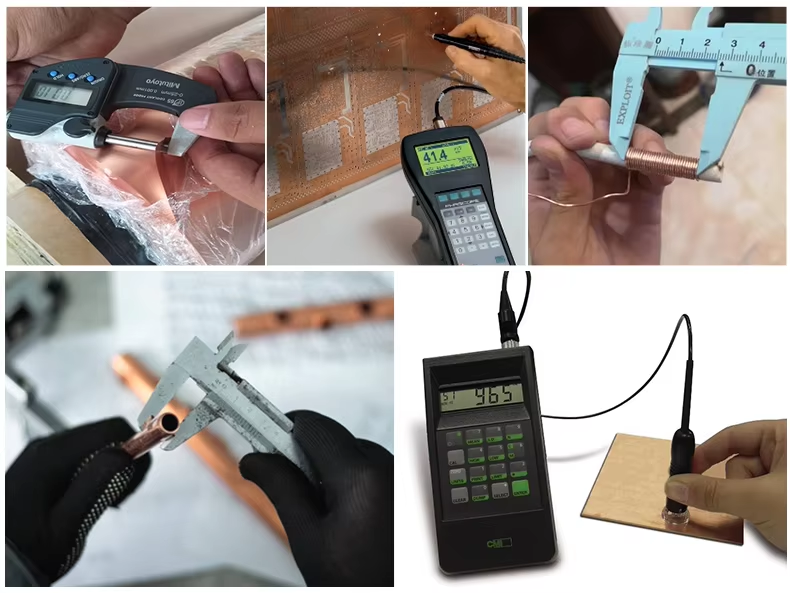
100% Inspection Per ASTM B111 / C68700 – Customer Witnessed
Every tube in this lot has passed third-party witnessed inspection per ASTM B111 standard for C68700 alloy. Below are actual photos from customer-onsite inspection, including eddy current testing and dimensional verification.
Inspection items verified:
• Eddy current testing (ECT) – no through-wall defects
• Outer diameter & wall thickness – within ±0.02mm tolerance
• Surface finish & temper (O61) – conforms to ASTM
• Hardness & chemical composition – certified.

Export-Ready Packing – Anti-Rust & Wooden Case
After passing inspection, all tubes are packed according to export standards and customer-specific requirements. The packing process is documented below to ensure traceability and damage-free delivery.
Packing steps shown in video & images:
1. Tube cleaning & drying
2. Plastic end caps on both ends
3. VCI anti-rust paper wrapping
4. Bundle strapping with moisture barrier film
5. Plywood wooden case (ISPM-15 compliant) with foam padding
6. Labeling with ASTM grade, lot number, and inspection stamp


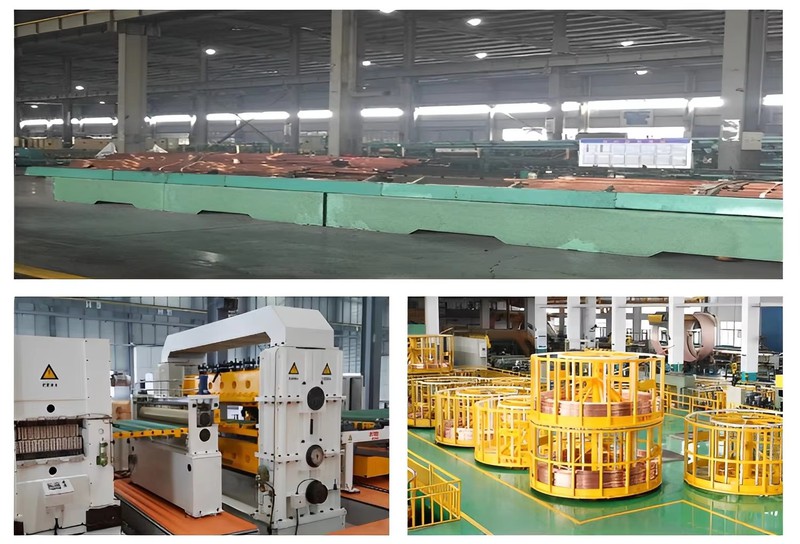
Our Factory & Equipment
All ASTM C68700 tubes are produced and inspected on our in-house equipment, allowing full process control from billet casting to final packing.
Key equipment used for this lot:
• Induction melting furnace – precise alloying (Cu + Zn + Al + As)
• Horizontal continuous casting – uniform billet structure
• Extrusion press (800T / 1630T) – seamless tube forming
• Cold drawing bench (5–40m) – dimensional accuracy to ±0.02mm
• Online eddy current tester (FOERSTER / MAC) – 100% NDT
• Ultrasonic wall thickness gauge – real-time monitoring
• Annealing furnace (controlled atmosphere) – temper O61
In-house metrology: Micrometers, pin gauges, optical comparator, hardness tester (HV/HRB)
All equipment is calibrated quarterly. Production records are traceable by lot number.
Copper & Copper Alloy Products – Supply Range
| Product Form | Common Alloys / Grades | Size Range | Standards | Typical Applications |
|---|---|---|---|---|
| Tube / Pipe | C12200, C11000, C68700, C70600, C71500, C44300, C27000 | OD: 4mm – 219mm Wall: 0.5mm – 20mm Length: up to 15m |
ASTM B68, B75, B111, B280, B359, B466 | Heat exchangers, condensers, HVAC, plumbing, oil coolers |
| Plate / Sheet | C11000, C12200, C26000, C26800, C52100, C68700 | Thk: 0.5mm – 50mm Width: up to 1200mm Length: up to 4000mm |
ASTM B152, B169, B103, B465 | Electrical parts, roofing, gaskets, industrial panels |
| Rod / Bar | C11000, C26000, C36000, C46400, C48500, C63000 | Dia: 3mm – 120mm Length: 1m – 6m (or custom) |
ASTM B16, B124, B138, B150, B453 | Valve stems, shafts, fasteners, machined components |
| Wire | C11000, C16200, C17500, C26000, C52100, C64700 | Dia: 0.1mm – 12mm Coil weight: up to 100kg |
ASTM B1, B2, B3, B197, B206, B624 | Welding electrodes, electrical conductors, springs, mesh |
| Strip / Foil | C11000, C19400, C26000, C26800, C52100, C70250 | Thk: 0.05mm – 3.0mm Width: 5mm – 600mm |
ASTM B36, B465, B694, B888 | Connectors, terminals, battery tabs, shielding, stamping parts |
Check Today's Stock & Lead Time


