

Why do heat exchanger engineers prefer C70600 for seawater?
C70600 resists seawater corrosion, prevents biofouling, and costs less than exotic alloys. Three reasons drive the choice.
First, corrosion resistance. C70600 forms a protective nickel‑iron oxide film in seawater. This film self‑repairs if damaged. Uniform corrosion rate is 0.025 mm/year or less. No pitting, no cracking.
Second, biofouling prevention. Copper ions slowly release from the tube surface. Barnacles, mussels, and algae will not attach. No other common tube material does this naturally.
Third, reasonable cost. C70600 sits between carbon steel (cheap but fails quickly) and titanium (excellent but expensive). For most seawater heat exchangers, C70600 is the best value.
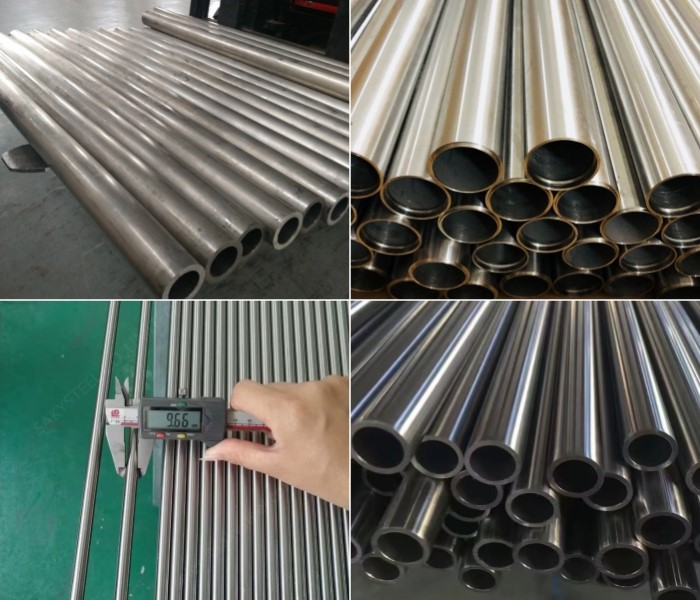
What tube wall thickness (BWG) is typical for C70600 heat exchangers?
BWG 18 (1.24mm) and BWG 16 (1.65mm) are the two most common wall thicknesses for C70600 heat exchanger tubes. The choice depends on seawater aggressiveness and pressure.
Typical BWG selection by application:
| Application | Common BWG | Wall mm |
|---|---|---|
| Small marine coolers, low pressure | BWG 18 | 1.24mm |
| Shipboard heat exchangers | BWG 18 | 1.24mm |
| Power plant condensers | BWG 18 or BWG 16 | 1.24-1.65mm |
| High pressure seawater coolers | BWG 16 | 1.65mm |
| Desalination evaporators | BWG 18 | 1.24mm |
| Offshore platform exchangers | BWG 16 | 1.65mm |
General rule: Thinner wall (BWG 18) for better heat transfer. Thicker wall (BWG 16) for higher pressure or longer corrosion allowance.
How does C70600 compare to other heat exchanger tube materials?
C70600 beats copper and brass in seawater. It loses to titanium in high velocity or high temperature service. But titanium costs 3-5x more. Here is how C70600 stacks up.
Comparison table for seawater cooled heat exchangers:
| Material | Corrosion resistance | Biofouling | Cost | Common use |
|---|---|---|---|---|
| C70600 (90/10 copper nickel) | Good | Excellent | Medium | Standard seawater |
| C71500 (70/30 copper nickel) | Better | Excellent | Medium+ | High velocity |
| Titanium | Excellent | None | Very high | Sand or very hot water |
| 316L stainless steel | Poor (pitting) | Poor | Medium | Avoid seawater |
| Aluminum brass | Fair (dezincification) | Good | Low | Older systems |
| C12200 copper | Poor | Poor | Low | Fresh water only |
For normal seawater heat exchangers, C70600 is the proven standard. Do not downgrade to aluminum brass or 316L. Do not upgrade to titanium unless you need to.
What seawater velocity and temperature limits apply to C70600 heat exchangers?
Stay below 2.5 m/s and 60°C for long term C70600 heat exchanger service. These are the two hard limits.
Velocity limit explained:
Below 1.5 m/s: safe, protective film stable
1.5 to 2.5 m/s: acceptable for continuous service
Above 2.5 m/s: impingement corrosion risk increases
Above 3.0 m/s: do not use C70600
Temperature limit explained:
Below 40°C: excellent, lowest corrosion rate
40 to 60°C: acceptable, monitor regularly
Above 60°C: corrosion rate accelerates sharply
Above 80°C: do not use C70600
How does C70600 perform over 10-20 years of heat exchanger service?
C70600 tubes typically last 20 to 30 years in properly designed seawater heat exchangers. The protective film stays stable. Corrosion rate is predictable. Fewer than 1% of tubes fail in the first decade.
| Year | Expected condition | Action |
|---|---|---|
| 1-5 years | Protective film fully formed. No measurable wall loss. | Normal operation |
| 5-10 years | Minor uniform corrosion (0.1-0.2mm total). | Eddy current inspection recommended |
| 10-15 years | Uniform corrosion continues. Some inlet end erosion if velocity high. | Inspect every 2 years |
| 15-20 years | Wall thickness reduced by 0.3-0.5mm. Still safe for most pressures. | Plan for retubing in 5-10 years |
| 20-30 years | End of life for most heat exchangers. Retube or replace. | Replacement |
What is the price difference between C70600 and other heat exchanger tube materials?
C70600 costs about 30-50% more than copper or brass, but 70-80% less than titanium. Here is a rough price comparison per kg.
| Material | Relative cost | Notes |
|---|---|---|
| C12200 copper | 0.6x | Do not use in seawater |
| Aluminum brass | 0.7x | Older alloy, lower reliability |
| 316L stainless | 0.8x | Pits in seawater |
| C70600 | 1.0x (baseline) | Standard choice |
| C71500 | 1.3x | For higher velocity |
| Titanium (Grade 2) | 3.5-5.0x | Best performance, highest cost |
Cheaper materials (copper, brass, 316L) fail in seawater. Replacement cost exceeds savings.
C70600 works and costs reasonably.
Titanium works perfectly but costs much more. Only specify titanium if velocity exceeds 4 m/s, temperature exceeds 80°C, or sand is present.
C70600 or C71500 for heat exchanger tube bundles?
Use C70600 for most seawater heat exchangers. Switch to C71500 only when velocity exceeds 2.5 m/s or temperature exceeds 60°C.
| Condition | Recommended grade | Reason |
|---|---|---|
| Velocity < 2.5 m/s, temp < 60°C | C70600 | Cost effective, proven |
| Velocity 2.5-4.0 m/s, temp < 60°C | C71500 | Higher erosion resistance |
| Velocity < 2.5 m/s, temp 60-80°C | C71500 | Better high temperature film |
| Velocity > 4.0 m/s or temp > 80°C | Titanium | C71500 not enough |
FAQ
Q1: Why is C70600 used for seawater heat exchangers?
C70600 offers three key benefits for seawater heat exchangers. First, it resists seawater corrosion with a self repairing oxide film. Second, it prevents biofouling because copper ions kill barnacles and algae. Third, it costs much less than titanium while lasting 20-30 years. No other tube material combines all three advantages at this price point.
Q2: What BWG is most common for C70600 condenser tubes?
BWG 18 (1.24mm wall) is the most common thickness for C70600 condenser tubes. Power plants and ships use BWG 18 for most applications. BWG 16 (1.65mm wall) is used for higher pressure or when extra corrosion allowance is needed. Thicker walls reduce heat transfer, so engineers specify the thinnest wall that still provides safety margin.
Q3: Can C70600 be used for evaporators?
Yes, C70600 works well in evaporators, not just condensers. However, pay attention to temperature. Evaporators often run hotter than condensers. Keep temperature below 60°C for C70600. Above that, move to C71500. Also check for two phase flow (water plus vapor) which can cause erosion even at moderate velocities.
Q4: How do you roll C70600 tubes into a tube sheet?
C70600 tubes are expanded into tube sheets using a rolling expander. The process is similar to other copper alloys. Use light oil as lubricant. Roll until the tube wall is firm against the tube hole. Do not over roll. Annealed C70600 (O60 temper) is easy to expand. Hard drawn C70600 should not be used for tube sheets because it may crack.
Q5: What is the typical fouling factor for C70600?
C70600 has a low fouling factor because it resists biological growth. For heat exchanger design, a fouling factor of 0.0002 to 0.0005 m²·K/W is typical for C70600 in seawater. This is significantly lower than carbon steel (0.001-0.002) or stainless steel (0.0005-0.001). Lower fouling factor means smaller heat exchanger for the same duty.
Q6: How long do C70600 heat exchanger tubes last?
20 to 30 years is typical for well designed C70600 heat exchangers. The protective film keeps corrosion rate under 0.025 mm/year. At this rate, a 1.24mm BWG 18 tube takes 40-50 years to lose half its wall thickness. In practice, other factors like inlet erosion or startup upsets cause failure before uniform corrosion does. Still, 20-30 years is excellent.
Q7: Can C70600 tubes be replaced individually?
Yes, individual C70600 tubes can be pulled and replaced without retubing the whole bundle. You cut the tube flush with the tube sheet on both ends, split it with a tube puller, remove it, and roll a new tube into the same holes. This is standard practice. Keep spare tubes in storage for this reason.
Q8: What happens if seawater velocity is too low in a heat exchanger?
Sediment settles and debris accumulates when velocity drops below 0.5-1.0 m/s. This is stagnation. Debris under deposits can create localized corrosion. Some marine growth may also attach at very low velocity. Maintain at least 1.0-1.5 m/s in C70600 tubes during operation. If velocity must be lower, increase inspection frequency.
Q9: Does C70600 require tube side or shell side seawater?
Seawater should always go through the tube side, not the shell side, when using C70600. Tube side flow allows easier cleaning, better velocity control, and simpler inspection. Shell side seawater with copper nickel tubes is rare and not recommended. Put seawater inside the tubes. Put cooling water or refrigerant on the shell side.
Q10: What is the maximum tube length for C70600 heat exchangers?
15 meters (about 49 feet) is the practical maximum for C70600 tubes without supports. Longer tubes risk sagging and vibration. For longer bundles, add intermediate tube supports. Tube length is not limited by C70600 material but by mechanical design. Some power plants use 20-25 meter tubes with multiple support plates.
Q11: Can I use C70600 for shell and tube heat exchangers?
Yes, C70600 is very common in shell and tube heat exchangers. In fact, most seawater cooled shell and tube heat exchangers use C70600 or C71500 tubes. The shell material is usually carbon steel, naval brass, or copper nickel depending on the seawater side. Tube sheets are often naval brass or copper nickel to match tube material.
Q12: How does C70600 compare to titanium for heat exchangers?
Titanium lasts longer but costs 3-5x more. C70600 is the value choice for normal conditions. Titanium resists all forms of seawater corrosion, even at high velocity and high temperature. It also does not biofoul. However, titanium is expensive and harder to roll into tube sheets. Use titanium for very aggressive jobs (sand, high velocity >4 m/s, temperature >80°C). Use C70600 for everything else.
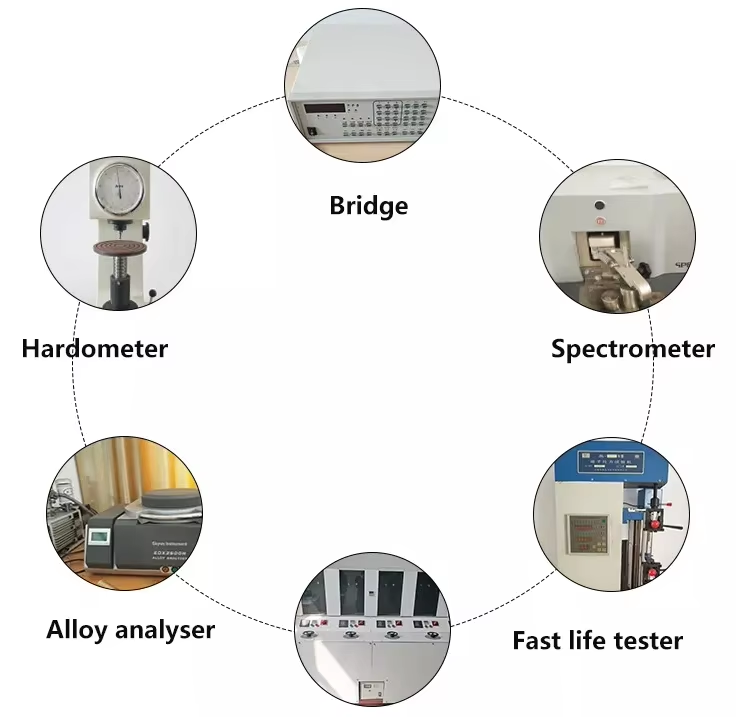
Our Testing
Each tube batch goes through 5 checks before shipping:
Chemistry → Spectrometer confirms Ni 9-11%, Fe 1.0-1.8% (ASTM E1473)
Strength → Pull test until break. Must hit 310 MPa minimum (ASTM E8)
Flaws → Eddy current probe runs through every tube. Any signal = reject (ASTM E243)
Ductility → Flatten a ring to 3x wall. No cracks allowed (ASTM B968)
Leaks → Hydrostatic pressure 3000 psi, hold for 10 seconds (ASTM B111)
You get a Mill Test Report with every order. Third party inspection (SGS, BV, Lloyds) available.
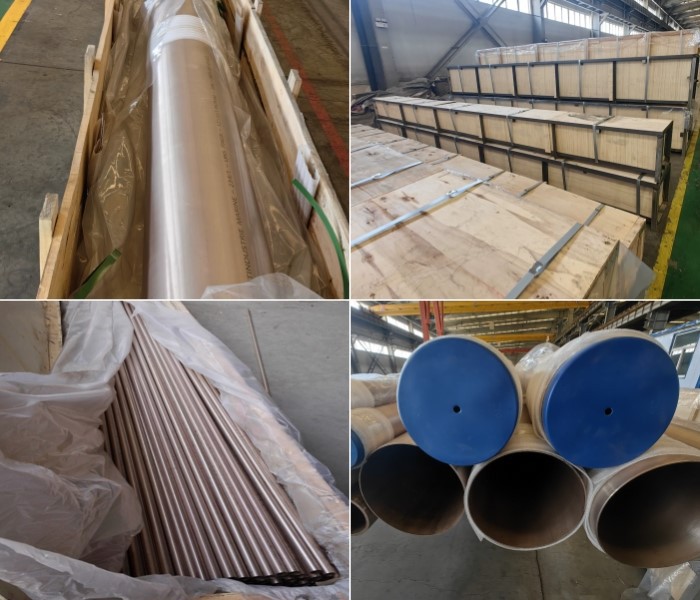
Our Packaging
Plastic caps on both ends
VCI paper between tube layers
Shrink wrap around each bundle
Steel strapping to secure bundle
Wooden case for small cut lengths or fragile sizes
Steel bundle + wooden pallet for 6-12m standard tubes
Waterproof label with grade, OD, wall, heat number, quantity
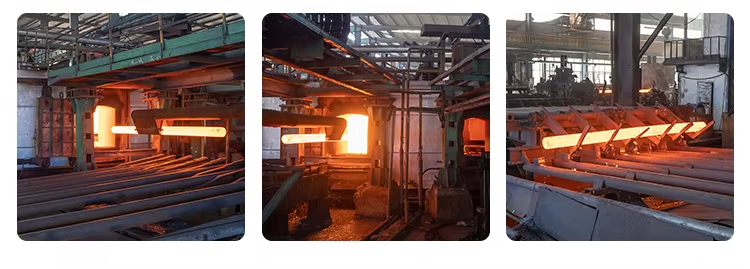
Our Factory Equipment
From raw material to finished tube in one plant:
Melting (3 furnaces, 5 tons each) → turns copper + nickel + iron into liquid alloy
Casting (2 lines) → pours liquid into solid billet, 80-220mm diameter
Extrusion (3500 ton press) → punches billet into hollow tube shell
Cold drawing (8 benches) → pulls shell through dies to shrink OD and wall
Annealing (4 furnaces) → heats tube to 600°C to soften after drawing
Straightening & cutting (3 lines) → makes tube straight and cuts to length
Testing (2 eddy current machines) → 100% inspection
Our Product Range
| Category | Shapes | Size range | Common grades |
|---|---|---|---|
| Copper tube | Round, square, rectangular, pancake coil, inner grooved | OD 3-219mm, wall 0.3-10mm | C11000, C12200, C70600, C71500, C26000 |
| Copper rod | Round, hex, square | Dia 2-120mm | C11000, C36000, C14500, C18200 |
| Copper wire | Round, flat, tinned | Dia 0.1-12mm | C11000, C16200, C17200 |
| Copper strip | Coiled, slit | Thk 0.05-3mm, width 5-400mm | C11000, C19400, C70250 |
| Copper foil | Thin foil | Thk 0.01-0.1mm | C11000, C10200 |
| CNC machined parts | Bushings, flanges, fittings, nuts | Custom drawing | C36000, C63000, C70600 |


